
Check out this article from MSNBC about the origin of blue eyes.
 To get you excited about the upcoming trip to Lotusland here are two articles about the gardens and their founder, Ganna Walska, Forget About Rubies – She Wanted Cycads from the Christian Science Monitor and What The Diva Wrought, published in the Wall Street Journal. This last article is hosted at the Lotusland website so click the links on the left for further information.
 One of the dangers in biology is to look at some characteristic and assume what forces led to its evolution without ever actually testing that assumption.
 The field of genetic testing is really being shaken up now that the first companies are offering a more complete DNA analysis (not sequencing yet, but that can only be a matter of time). The company I was thinking of when I mentioned it was 23and me (is it just me or is that a very uncatchy name?). They have a fairly informative website that you might enjoy browsing as long as you remember they are in the business to sell a product. The bottomline, which you'll have to search around to find, is that they read 550,000 single nucelotide polymorphisms that are spread across your entire genome. This is a small fraction of the 10 million SNPs that are estimated to be in the human genome.
 I think I might have sent you this link in an e-mail if you took the Biology colloquium last quarter, but I just realized it is well worth another look for our class because it considers the incorporation of microbial genes into the human genome.
  There was an interesting article in New Scientist magazine last year on Evolution's greatest mistakes. The article covers seven areas of human biology, plus an additional 15 in list form, where evolution has made the best of a bad job, and where it would be hard to argue that any 'intelligent' design' has been going on. Unfortunately reading the article requires a subscription to the magazine. From a UCSB computer, or using a proxy server, open a new tab and click the 'off-campus access' link on the main UCSB library website and login. After you've done that you can try clicking here (or right click here now to copy this link location).
 It's a crazy design: like keeping the repair manual for a steam engine by the furnace, where it inevitably becomes charred and unreadable. The slow loss of function as mutations accumulate in mitochondrial DNA may be the main cause of ageing and, some believe, of many age-related diseases, from diabetes to Alzheimer's.
The DNA is there because of our evolutionary history. Mitochondria are the remnants of a once independent bacterium that formed a symbiotic alliance with our cells around 2 billion years ago. Over time, many of the bacterium's original genes have been lost or jumped to the cell nucleus, but human mitochondria still retain 13 genes.
Anti-ageing research is already exploring ways of moving the remaining genes to the safety of the nucleus. It will not be easy. The 13 genes cannot simply be moved to the nuclear genome, because then the 13 proteins will be made outside the mitochondria where they are needed. A solution might be to get the mRNA recipes for proteins delivered to the mitochondria, so the genes reside in the nucleus but the proteins are still made inside the mitochondria.'
 Just when it looked like the red queen hypothesis was gaining the upper hand as an explanation for the prevalence of sex across the animal and plant kingdoms it has started to struggle to explain why species have so much sex. Why not reproduce asexually most of the time to get the benefits of that strategy and throw in a little sexual reproduction here and there for variety (literally)?
 If you consider inbreeding between humans it is clear that to avoid it your ancestors would need to be unrelated. But in this case your ancestors simply get more and more numerous the further and further back you go.
 Hmmm, I just got totally confused and posted this on the blog for my disease class (it is disease related after all) and then was about to post the amusing German rock video here when I realized something was wrong. Anyway, here's the post I meant to put here. I found this report on Giardia risk in the Sierras to be a very sensible approach to what is probably a low risk. As the author points out, basic hygiene, such as hand washing, is probably far more important than water filtering. Now I bet you all want to see the amusing German rock video anyway but you'll just have to head over to the eemb40 disease blog for that.
 'Tree Of Life' Has Lost A Branch, According To Largest Genetic Comparison Of Higher Life Forms Ever.
 Listen! A frog
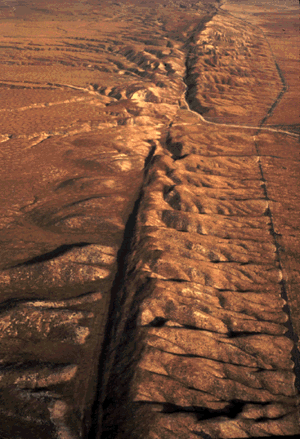 We are finding more and more microbes living deep within the earth's crust. Some of them have been found several kilometers down. A new paper is Astrobiology suggests that earthquakes might be important in supplying the nutrient rich rocks that sustain the bacteria and calculations suggest that seismic events happen regularly enough to sustain microbial life in this way for billions of years.
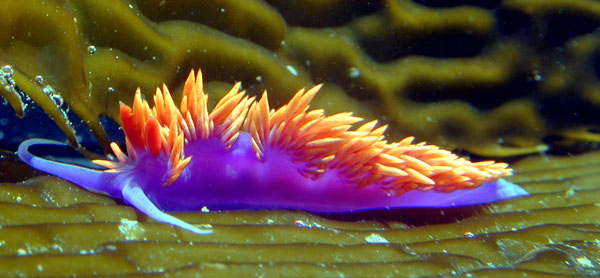 There are not only great low tides over the weekend but they are at civilized times of the day! Hopefully you can all get out there sometime. Let us know what you find. There's a really nice tide pool website at Santa Barbara City College with a great many of the beautiful pictures taken right by UCSB campus so these are the plants and animals you will see. Check out the 'Treasures' page. These are some of the organisms you might catch sight of with such a low tide. Assuming you live close to campus then Campus Point and Devereux Point (Coal Oil Point) are both great locations.

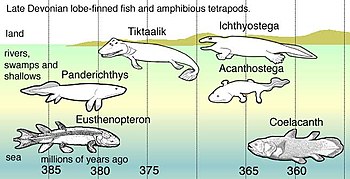
 You can find Erasmus Darwin's work at the Internet Archive Open-Access Text Archive - a wonderful resource with over 200,000 items, most of them out of copyright or otherwise in the public domain.
 A short report in Science in 2006 described an 'Early Cretaceous Spider Web with Its Prey'. This was the worlds oldest preserved spider web. Preserved in a large blob of amber the web and the insects caught in it have now been dated to the early Cretaceous - about 110 million years ago.
 One of the best pieces of advice to a young scientist is to read, and read widely. The internet has made this whole lot easier and there are numerous sites out there that will direct you to papers worth reading in whatever areas your interest takes you. Over the next few weeks we will be covering a number of topics in evolution. Two blogs that are worth checking out for some clear writing and interesting links on these topics are:
 Earlier last year John McCain was asked in a primary debate whether he believed in evolution. After a pause, McCain said, “Yes.” The moderator then asked the rest of the ten republican candidates on stage “I’m curious, is there anybody on the stage that does not agree — believe in evolution?” Three raised their hand: Sam Brownback, Mike Huckabee, and Tom Tancredo. This proportion (3/10) is actually not that out of line, and probably lower than, the proportion of Americans as a whole who reject evolution - see numerous opinion polls, the National Center for Science Education collects several together here. I'm posting this now because I saw this posting on a blog a couple of days ago that summarizes the position of all the presidential candidates on evolution. Agree with it or not you have to love the response by Mike Gravel when asked if he thought creationism should be taught in public schools
 I've never had enough time to investigate it fully but the Interactive Tree of Life looks like an amazing tool that provides a whole suite of ways to represent, manipulate, and display phylogenetic trees. One of my interests is in the graphical representation of data (see Edward Tufte's forum/blog for some superb discussions on this) and the Interactive Tree of Life website combines both this and biology. Presenting such complex data in a way that people can understand is not easy so it's great to be able to see a whole bunch of different attempts at this - you can scroll through several on the right hand side of the webpage. A related way of presenting the complexity of a tree of life is the hyperbolic tree approach at the Deep Green website. Notice how you can pick up nodes and move through the tree.
 The mimivirus debate is another chunky debate to get your teeth into. There are several hypotheses for where mimiviruses fit in the tree of life and including them as a fourth domain is only one suggestion. The wikipedia article is a good place to start and there's another good Discover article on the story but for something a little meatier try this PNAS paper with the title: 'Three RNA cells for ribosomal lineages and three DNA viruses to replicate their genomes: A hypothesis for the origin of cellular domain.'
 “This would be very similar to a set of politicians who decided to bypass the Constitution to create a whole new set of laws.”
 Possibly breaking my own rule of having posts be relevent to the current or past class I will stretch a point by saying that today I did mention the Cretaceous-Tertiary extinction event (aka the one that killed the dinosaurs). I have the Wikipedia main page as my home page and when I logged on today I found today's featured article was on the Chicxulub crater underneath the Yucatan peninsula in Mexico. This is the impact crater made by the impacting asteroid that current scientific opinion thinks plays a big role in the Cretaceous-Tertiary extinctions. It's a nice article giving you some idea of the scale of this impact. The animation (click the picture above) helps understand the formation of the crater. The story of the craters discovery, before the asteroid impact theory, is interesting too.
 Okay I confess I took this from a previous blog posting but I couldn't resist.....