In the LA Times this week:
Science has lost its way, at a big cost to humanity
Researchers are rewarded for splashy findings, not for double-checking accuracy. So many scientists looking for cures to diseases have been building on ideas that aren't even true.
Take a look at the article. Do you agree? If so, it is a problem that the next generation of scientists (ie you) are going to have to face.
"The journals want the papers that make the sexiest claims," he says. "And scientists believe that the way you succeed is having splashy papers in Science or Nature — it's not bad for them if a paper turns out to be wrong, if it's gotten a lot of attention."
For Biology students in the College of Creative Studies at the University of California Santa Barbara.
Wednesday, October 30, 2013
Monday, October 21, 2013
Probing the Secrets of Alzheimer's Disease
The UCSB Beckman Scholars Program and the Department of MCD Biology are sponsoring a special seminar:
Monday, October 28, 2013
1230-130 PM
MSRB Auditorium (room 1302)
Larry Goldstein, PhD
Distinguished Professor
Dept Cellular and Molecular Medicine, Dept Neurosciences
Director, UCSD Stem Cell program
Scientific Director, Sanford Consortium for Regenerative Medicine
UC San Diego School of Medicine
Probing the Secrets of Alzheimer's Disease Using Human Pluripotent Stem Cells
Monday, October 28, 2013
1230-130 PM
MSRB Auditorium (room 1302)
Larry Goldstein, PhD
Distinguished Professor
Dept Cellular and Molecular Medicine, Dept Neurosciences
Director, UCSD Stem Cell program
Scientific Director, Sanford Consortium for Regenerative Medicine
UC San Diego School of Medicine
Probing the Secrets of Alzheimer's Disease Using Human Pluripotent Stem Cells
Tuesday, October 8, 2013
URCA Grants
The College of Letters and Science Undergraduate Research and Creative
Activities (URCA) Unit is now accepting grant proposals for the 2013-14
academic year. Undergraduates, regardless of class level and college
affiliation, may submit a proposal for funding to support their research
and creative projects.
The deadline to submit an URCA grant proposal is FRIDAY NOVEMBER FIRST , 2013. Funding is limited to $750 per individual project, group projects will not be considered. Application guidelines and the online submission form may be found on the URCA web site,
http://www.duels.ucsb.edu/urca
To prepare a proposal, please view the presentation of a workshop on preparing a presentation by working the links at the bottom of the page on URCA grants. (URCA Project Grant Proposal Workshops)
The deadline to submit an URCA grant proposal is FRIDAY NOVEMBER FIRST , 2013. Funding is limited to $750 per individual project, group projects will not be considered. Application guidelines and the online submission form may be found on the URCA web site,
http://www.duels.ucsb.edu/urca
To prepare a proposal, please view the presentation of a workshop on preparing a presentation by working the links at the bottom of the page on URCA grants. (URCA Project Grant Proposal Workshops)
Monday, September 30, 2013
Undergraduate Marine Resources Population Dynamics Workshop
This was sent to me from Bruce who received it from an ex-CCS student. It sounds like a GREAT opportunity.
The 11th annual Undergraduate Marine Resources Population Dynamics (MRPD) Workshop
March 2-8, 2014
Keys Marine Lab in Long Key, Florida.
The NMFS RTR Program, located at the University of Florida, is holding its eleventh annual Marine Resources Population Dynamics Workshop. This workshop will introduce fifteen outstanding undergraduate students from around the country to the field of population dynamics using high-profile examples from harvested fish species and protected species (such as sea turtles or marine mammals). The workshop will take place March 2-8, 2013 at the Keys Marine Lab in Layton, FL. The program will cover all costs for the students selected to participate. The workshop is designed for US Citizens who have strong math skills and enjoy math, who also have a basic understanding of ecology. For more information and application materials, please visit www.popdyrtr.com or http://fishweb.ifas.ufl.edu/rtr/index.shtml
Deadline for receipt of applications is November 17, 2013 by 11:59 PM EST
The 11th annual Undergraduate Marine Resources Population Dynamics (MRPD) Workshop
March 2-8, 2014
Keys Marine Lab in Long Key, Florida.
The NMFS RTR Program, located at the University of Florida, is holding its eleventh annual Marine Resources Population Dynamics Workshop. This workshop will introduce fifteen outstanding undergraduate students from around the country to the field of population dynamics using high-profile examples from harvested fish species and protected species (such as sea turtles or marine mammals). The workshop will take place March 2-8, 2013 at the Keys Marine Lab in Layton, FL. The program will cover all costs for the students selected to participate. The workshop is designed for US Citizens who have strong math skills and enjoy math, who also have a basic understanding of ecology. For more information and application materials, please visit www.popdyrtr.com or http://fishweb.ifas.ufl.edu/rtr/index.shtml
Deadline for receipt of applications is November 17, 2013 by 11:59 PM EST
Thursday, June 20, 2013
Bacteria Bubble!
According to the article, "Bacteria Live at 33,000 Feet" , which is apparently also in the July 2013 issue of Popular Science, scientists found bacteria living at extremely high elevations in our atmosphere. A lot of what was previously regarded as just dust turned out to be microbial organisms.
It seems like life is found in weirder and cooler spots every day! It also raises a lot of interesting questions about what effect these organisms have on the Earth.
Monday, June 10, 2013
Paleo-pathology, the Medici children and rickets: They needed to play outside more!
Rickets in the news.... We think of vitamin deficiency as being a problem in the developing world, not a disease of the wealthy. But according to a story I heard today on PRI's: The World, rickets affected the wealthy aristocratic family of the Renaissance - the Medici's whose children suffered from this disease and died young.
From the PRI website: "there’s a new insight into what life was like during the Italian Renaissance. The insight comes from a team of Italian researchers that examined the skeletons of nine children of the Medici family who died in the 16th century." Interestingly, "it turns out that serious malnutrition in the form of a Vitamin D deficiency was an unintended consequence of the Medicis privileged 16th century upbringing." Weird, right? Can you think of how a privileged lifestyle might PROMOTE rickets? Read the article to see if you are right...
![]() |
| 1586 portrait of the Grand Duchess of Tuscany and her son don Filippino de’ Medici (Photo:Galleria degli Uffizi, Firenze) |
From the PRI website: "there’s a new insight into what life was like during the Italian Renaissance. The insight comes from a team of Italian researchers that examined the skeletons of nine children of the Medici family who died in the 16th century." Interestingly, "it turns out that serious malnutrition in the form of a Vitamin D deficiency was an unintended consequence of the Medicis privileged 16th century upbringing." Weird, right? Can you think of how a privileged lifestyle might PROMOTE rickets? Read the article to see if you are right...
Sunday, June 9, 2013
Limb Regeneration
We can now add limb regeneration to the list of things that immune systems are responsible for. Axolotls (such as the one pictured above) have been known to easily regenerate lost limbs, but the mechanisms for limb reproduction have largely been a mystery.
Researchers have found that when Axolotls depleted of macrophages loose a limb, they grow stumps and scars; but when immune cells are replenished and the wound re-opened, a complex signaling process begins between the macrophages and the surrounding tissue and the limb begins to regrow. While the exact process of limb regeneration is far from determined, we now know that immune cells are key to limb regeneration.
Saturday, June 8, 2013
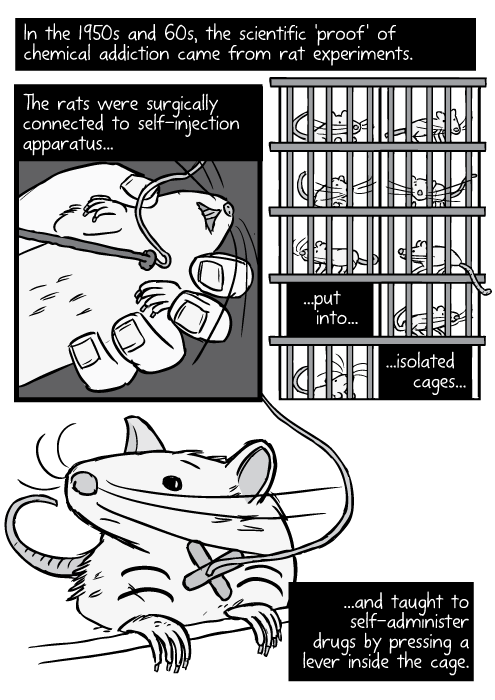
Rat Park
http://www.stuartmcmillen.com/comics_en/rat-park/
Though a bit sensational and lengthy, I think it shows a more human side of research and the struggles that researchers face. Take the time to read it, you won't be disappointed.
Friday, June 7, 2013
Wholphin?
I know, it sounds ridiculous, I even thought it was a joke when I heard it from my History teacher (as did many of you when I told you at the Museum), but the wholphin is a very real thing (or at least nbc news thinks so). Here is the source http://www.nbcnews.com/id/7508288/ns/technology_and_science-science/t/whale-dolphin-hybrid-has-baby-wholphin/#.UbKZfvb71Fo. Apparently, a chance mating between a female False Killer Whale and a male Atlantic Bottlenose Dolphin produced an offspring together. Even more incredibly, the offspring has given birth twice.
Who knows? Maybe the story is false, maybe it's real, either way, it's interesting, and it never hurts to look at biology from another angle.
Laser Controlled Flies
In response to Jimmy's presentation on Thursday, I thought I'd mention another interesting control mechanism used on insects. It turns out that in addition to remote controlled cockroaches, laser controlled flies have also been created.
This fly control system functions through the genetic modification of specific neuron cells in the flies brain. These cells are engineered to have a different ion channel than the one that is normally present. The final key to building a laser controlled fly was the injection of ATP in molecular cages, which will open up and release ATP into the flies brain when struck with UV light. This whole system was engineered into the giant fiber system of the flies brain, the center responsible for behavior such as jumping and flight. These behaviors are triggered when the flies is struck with UV light which releases ATP and triggers the genetically modified ion channel. This flow of events causes the fly to perform the desired behavior as much as 80% of the time. These laser controlled flies are being used to study many different components of neuron functioning.
Here's a link to the paper:
http://www.sciencedirect.com/science/article/pii/S0092867405001157
Here's a link to the paper:
http://www.sciencedirect.com/science/article/pii/S0092867405001157
Thursday, June 6, 2013
Yoga Makes You Smarter!
Its a little off topic, but I stumbled across this article and I thought I could relate it to our discussion of the brain on Tuesday. The University of Illinois recently did a study that tested subjects on their memory and mental control after a 20 minute yoga session and after a 20 minute cardio session. They were surprised to find that subjects performed significantly better after the yoga session than the cardio session. So here's to even more reasons to take some time every day to relax, stretch, and do something good for your body! Here's the citation for the article; its a pdf so you'll have to download it off google scholar but its definitely worth reading!
Gothe N, Pontefex MB, Hillman C, McAuley E. The Acute Effects of Yoga on Executive Function. Journal of Physical Activity & Health, 2013
Wednesday, June 5, 2013
Approval for Blood Grown from Culture
Synthetic blood has been approved for clinical trials in the Scottish Center for Regenerative Medicine. While getting blood from culture (instead of donations) may prove to be a lot of work in developed countries, it could be a godsend for developing countries which lack the networks required to reliably gather blood from donations. This source of blood will also have the advantage being easily controlled so it will always be O-negative and pathogen free.
The entire article can be found here.
Organ Donations
During our discussion of the human immune system, a couple comments about organ donation were brought up. According to the US Department of Health and Human Services, 118,228 people are waiting for an organ, and 18 people will die everyday waiting for an organ. I did some more research on the topic and found some interesting points regarding the more legislative side of it. As briefly mentioned in class, there are two main ways countries deal with consent for organ donation: opt-in vs. opt-out. In the opt-in method, donors give explicit consent, while in the opt-out method citizens will be
on the list unless they choose to be removed. As would be expected the opt-out system dramatically increases the percentage of the population that gives consent. For example Austria uses the opt-out system and has 99.98% consent rate, while one of its neighboring countries, Germany uses the opt-in system and only has a rate consent of 12%. In the US, citizens and residents, have the option to opt-in when they get or renewal a driver's license as well as register online. The two main agencies that govern Organ Procurement Organizations are in the US are the United Network for Organ Sharing (UNOS) and Organ Procurement and Transplant Network (OPTN). UNOS uses a computer program that generates matches based on criteria including distance, blood type and status. Lives of people around the world have been saved through organ donations, so the next time you go to the DMV remember that one organ donor can save up to 8 lives.
Where Are All My Friends?
I was very dismayed to hear from my parents that Brood II of Magicicada septendecim, the 17-year periodical cicada, has almost completely bypassed New York City. I've been trying to talk them into catching some for weeks now, and apart from these few my sister saw on a college tour of Bard, they've apparently been scarce:
Just be glad that our campus isn't overrun with these majestic, 2-inch long insects, which were apparently getting stepped on by all the students. I've been following several cicada-tracking websites, hoping to find an emergence that isn't 3 hours away by car. Here is the most recent disappointing image:
As you can see, New York is pretty devoid of interesting bugs, and has been since the last cicada emergence in 1996. Apparently they brood underground and their eggs are laid in old-growth trees that haven't been disturbed, a rarity in a city whose infrastructure changes almost daily.
The two other species of cicada with 17-year life cycles are markedly different: M. septendecula has a smaller body with thinner orange markings, and M. cassini is all black. From what I've learned in EEMB 116, a class you should not take unless you enjoy handling things with lots of legs, these species and several others that emerge every 13 years have synchronized their life cycle to prime numbers to prevent the prediction of their next emergence by predators, of which they have many. Brood II, one of 17 Northeastern populations and one of 12 broods synchronized to a 17-year cycle, is the most NYC-centric; Brood X covers the largest geographic range in the U.S. and Brood IV is known for the densest outbreaks: up to 1,000 individuals per square meter in Kansas!
Louis Sorkin, an entomologist at the Museum of Natural History (where I'm working this summer) bravely answered the questions of many an anxious city slicker:
"The eggs are deposited by the females by slicing into smaller branches with the ovipositor. Eggs require 6 to 10 weeks of incubation. The newly hatched nymphs are smaller than the size of a grain of rice. These fall to the ground. I suppose if you stayed under trees at the time of hatching, you could be pelted by these nymphs. Other than that, their activity will mostly go unnoticed. Emergence of nymphs and progression to mature adults with chorusing and mating continues for a few weeks. The adults have to feed on tree fluids, too. So probably 4 to 6 weeks, but is temperature dependent, so cooler conditions slow things down and warmer conditions speed things up. I'm not sure how long it takes for the shed skins or exuviae to decompose completely, but they are quite resilient. Bodies of dead cicadas also take time to decompose. Foraging ants will probably cut them up to bring back to the nest to feed the larvae. You can use the dead cicada bodies for plant fertilizer."
How practical. Cicadas neither bite nor sting, and belong to the suborder Auchenorrhyncha along with leafhoppers and spittlebugs. As Sorkin said, they feed by tapping into plant xylem, and on rare occasion have been known to mistake a particularly beefy human arm for a branch if they are allowed to remain there for an extended period of time. The long, sharp stylet that they usually use to pierce through bark is said to be quite painful.
Here is an interesting article on the museum's restored cicada display if you're interested in further reading.
Just be glad that our campus isn't overrun with these majestic, 2-inch long insects, which were apparently getting stepped on by all the students. I've been following several cicada-tracking websites, hoping to find an emergence that isn't 3 hours away by car. Here is the most recent disappointing image:
As you can see, New York is pretty devoid of interesting bugs, and has been since the last cicada emergence in 1996. Apparently they brood underground and their eggs are laid in old-growth trees that haven't been disturbed, a rarity in a city whose infrastructure changes almost daily.
The two other species of cicada with 17-year life cycles are markedly different: M. septendecula has a smaller body with thinner orange markings, and M. cassini is all black. From what I've learned in EEMB 116, a class you should not take unless you enjoy handling things with lots of legs, these species and several others that emerge every 13 years have synchronized their life cycle to prime numbers to prevent the prediction of their next emergence by predators, of which they have many. Brood II, one of 17 Northeastern populations and one of 12 broods synchronized to a 17-year cycle, is the most NYC-centric; Brood X covers the largest geographic range in the U.S. and Brood IV is known for the densest outbreaks: up to 1,000 individuals per square meter in Kansas!
Louis Sorkin, an entomologist at the Museum of Natural History (where I'm working this summer) bravely answered the questions of many an anxious city slicker:
"The eggs are deposited by the females by slicing into smaller branches with the ovipositor. Eggs require 6 to 10 weeks of incubation. The newly hatched nymphs are smaller than the size of a grain of rice. These fall to the ground. I suppose if you stayed under trees at the time of hatching, you could be pelted by these nymphs. Other than that, their activity will mostly go unnoticed. Emergence of nymphs and progression to mature adults with chorusing and mating continues for a few weeks. The adults have to feed on tree fluids, too. So probably 4 to 6 weeks, but is temperature dependent, so cooler conditions slow things down and warmer conditions speed things up. I'm not sure how long it takes for the shed skins or exuviae to decompose completely, but they are quite resilient. Bodies of dead cicadas also take time to decompose. Foraging ants will probably cut them up to bring back to the nest to feed the larvae. You can use the dead cicada bodies for plant fertilizer."
How practical. Cicadas neither bite nor sting, and belong to the suborder Auchenorrhyncha along with leafhoppers and spittlebugs. As Sorkin said, they feed by tapping into plant xylem, and on rare occasion have been known to mistake a particularly beefy human arm for a branch if they are allowed to remain there for an extended period of time. The long, sharp stylet that they usually use to pierce through bark is said to be quite painful.
Here is an interesting article on the museum's restored cicada display if you're interested in further reading.
Breasts and Antibiotics
Due to the modern overuse of synthetic antibiotics many nasty bugs have developed antibiotic resistant strains causing us to search for unique innovations to stop pesky bacteria from infecting our body. It turns out that human milk contains a unique and natural protein currently named Hamlet. This protein has shown its effectiveness as an antibacterial agent which not only effectively kills the bacteria but does so without severe side effects. The bacteria also seems unable or significantly slower at evolving a resistance to this protein
compared to synthetic antibiotics.
Article
Paper
compared to synthetic antibiotics.
Article
Paper
Tuesday, June 4, 2013
Cicadas Annoy Everyone Except the US Navy
You know those super annoying insects that sit around and buzz with that un-ending hum that slowly eats away at your brain? They're called Cicadas, and every 17 years the Brood II Cicada digs its way out of the earth under the East Coast to drive everyone nuts in a scattered attempt to attract mates.
The insect has an air-filled cavity in its thorax that is sided by two large plates. It alternates the contraction of the two plates at a rapid pace to produce two distinct clicking patterns against the underlying ribs. both of these patterns resonate within the hollow cavity and amplify each other to produce the dreaded cicada hum.
The US Navy has taken an interest in the insect in an effort to use this mating call as a sound producing mechanism for a new active sonar system. As it is now, these sonar systems are too large and complicated to be incorporated into most of the navy's vessels, so passive systems are used instead, which can only detect moving objects louder (and usually bigger) than the vessel collecting sound. The active system would project sound and collect it as it bounces off of objects, regardless of their sizes, and should be more compact.
Feel free to read more:
Popular Science
LA Times
Lawrence Woodworth Jr & Wikimedia Commons
The insect has an air-filled cavity in its thorax that is sided by two large plates. It alternates the contraction of the two plates at a rapid pace to produce two distinct clicking patterns against the underlying ribs. both of these patterns resonate within the hollow cavity and amplify each other to produce the dreaded cicada hum.
The US Navy has taken an interest in the insect in an effort to use this mating call as a sound producing mechanism for a new active sonar system. As it is now, these sonar systems are too large and complicated to be incorporated into most of the navy's vessels, so passive systems are used instead, which can only detect moving objects louder (and usually bigger) than the vessel collecting sound. The active system would project sound and collect it as it bounces off of objects, regardless of their sizes, and should be more compact.
Feel free to read more:
Popular Science
LA Times
A Fairly Annoynig Example of Evolution
Cockroaches are a versatile group of insects. They can go weeks without food, tolerate 15 times the radiation that humans can and are resistant to many pesticides.
Cockroaches have historically relied heavily on glucose as a food source but in the span of the last few decades, many cockroaches have evolved to reject glucose because it is so commonly used as a bait in insect traps. Researchers have found that in many modern cockroaches it stimulates the neurons that sense bitter foods, making glucose unattractive as a food. Because these glucose-averse cockroaches have become so common, traps that use glucose as a bait have become ineffective.
An article about this topic can be found here.
Sunday, June 2, 2013
GMO Wheat Found in Oregon Field... Wait What?!?!?
![]() |
| Not quite 'amber waves of grain' anymore |
Tuesday, May 28, 2013
Send Your Haiku To Mars! NASA Seeks Poets
This project reminds me of the CCS spirit...Putting creativity into scientific work. For all of you closet poet biology majors, here's your chance to make your name known...IN SPACE!
Monday, May 27, 2013
Swallowed by a blue whale?!
We had a nice visit to the SB Museum of Natural History, didn't we?! Here's our group photo inside the rib cage of the blue whale skeleton out front.
Some more information about the Museum, from a previous post....
Paul Collins, Curator of Vertebrate Zoology, had a paper in PNAS in 2010. This is a great example of how museums can be used for research and how the original collectors could have had no idea about the uses their collections would be put to.
The paper concerns a story relevant to our ecology section - the changes in the food web on the California Channel Islands: Pleistocene to historic shifts in bald eagle diets on the Channel Islands, California
There have also been a couple of articles in the local Independent newspaper about the museum:
Some more information about the Museum, from a previous post....
Paul Collins, Curator of Vertebrate Zoology, had a paper in PNAS in 2010. This is a great example of how museums can be used for research and how the original collectors could have had no idea about the uses their collections would be put to.
The paper concerns a story relevant to our ecology section - the changes in the food web on the California Channel Islands: Pleistocene to historic shifts in bald eagle diets on the Channel Islands, California
There have also been a couple of articles in the local Independent newspaper about the museum:
Sunday, May 26, 2013
Pygmy mammoths
How did mammoths reach the channel islands?
From the National Park Service Channel Islands website:
With their snorkel-like trunk and buoyant mass, elephants, living relatives of mammoths, are considered excellent distance swimmers, among the best of all land mammals, and skilled at crossing watergaps. Documented accounts demonstrate that Asian elephant swim to islands they cannot even see – some up to 23 miles away—guided by the odor of ripening fruit and vegetation. There is no reason that Pleistocene mammoths were not just as seaworthy, and just as good at swimming.
We don't know if prehistoric man rode pygmy mammoths.
But they probably did!
From the National Park Service Channel Islands website:
With their snorkel-like trunk and buoyant mass, elephants, living relatives of mammoths, are considered excellent distance swimmers, among the best of all land mammals, and skilled at crossing watergaps. Documented accounts demonstrate that Asian elephant swim to islands they cannot even see – some up to 23 miles away—guided by the odor of ripening fruit and vegetation. There is no reason that Pleistocene mammoths were not just as seaworthy, and just as good at swimming.
We don't know if prehistoric man rode pygmy mammoths.
But they probably did!
Thursday, May 23, 2013
Wallace's frog
A nice little article about Wallace's frog in the current edition of the Scientist.Wallace painted this watercolor of Rhacophorus nigropalmatus in 1855. A newly discovered species, the frog was found in a part of Borneo’s rainforest that echoed with the sounds of workers felling trees and transporting coal. The disturbance brought a diverse range of creatures out of hiding and, in the case of the frog, into the scientific record books.
...
He later discussed the species, named Rhacophorus nigropalmatus or “Wallace’s frog,” as an example of evolution’s stepwise process in his 1869 book The Malay Archipelago, in which he included a woodcut based on his original frog painting: “[I]t is very interesting to Darwinians as showing that the variability of the toes which have been already modified for purposes of swimming and adhesive climbing, have been taken advantage of to enable an allied species to pass through the air like the flying lizard.”
Wednesday, May 22, 2013
Cheap Gene Cloning...
In case anyone has $50 and 5 hours with an interest in cloning genes from home:
Popular science has posted a how-to article on making a PCR machine from common household objects. The tubular device uses the heat of a light bulb and the cooling of a computer fan to progress through the stages of the polymerase chain reaction. Unfortunately you have to provide your own test tubes, primers, and genetic material (not included with the set up).
Click the link for a cool video and a brief description of PCR:
Happy Cloning!
"Gene Machine" article on Popular Science
Popular science has posted a how-to article on making a PCR machine from common household objects. The tubular device uses the heat of a light bulb and the cooling of a computer fan to progress through the stages of the polymerase chain reaction. Unfortunately you have to provide your own test tubes, primers, and genetic material (not included with the set up).
Click the link for a cool video and a brief description of PCR:
Happy Cloning!
"Gene Machine" article on Popular Science
Tuesday, May 21, 2013
Human stem cells cloned for the first time
Video of the cell manipulation process filmed using a microscope equipped with a video camera from OHSU Video on Vimeo.
For the first documented time (ever), scientists were able to create new human stem cells by cloning order. This could, possibly, lead to cells to be grown to fit specific functions within an individual without the necessity of immunosuppresent drugs and the drawbacks of getting a trasplant from a donor.
Cool eyh? Maybe we won't need to freeze our placentas in future generations if we can prefect this cloning strategy.
Friday, May 17, 2013
Alligator Stem Cells Offer Hope for Tooth Regeneration in Humans
As the son of two dentists, teeth have always been a strange fascination. Now imagine my excitement when I read that ALLIGATORS may be the answer to losing our adult teeth. Researchers have looked into alligator stem cells as hope for tooth regeneration in humans as alligators also have implanted teeth. Not only that, they can be replaced up to 50 times over their lifetime!
Though this work has just started, researchers said "In the future, we hope to isolate those cells from the dental lamina to see whether we can use them to regenerate teeth in the lab."
How awesome would that be? Part human, part alligator. Manalligator if you will.
Stay classy.
Though this work has just started, researchers said "In the future, we hope to isolate those cells from the dental lamina to see whether we can use them to regenerate teeth in the lab."
How awesome would that be? Part human, part alligator. Manalligator if you will.
Stay classy.
Thursday, May 16, 2013
Honey and Hexagon
![]() |
| My precious... |
Another observation that was made on the YouTube video that is in the article was that the size of the honeycombs are about the size of the bee. Apparently, the size of the honeycomb is proportional to the size of the bee. I thought that this was an interesting observation.
On a last note, for those of you who actually read this article, may I bring your attention to the credits on the hand-drawn pictures. I found it amusing and a little amazed that the pictures are by Krulwich. Nice pics, Krulwich! ;-)
Wednesday, May 15, 2013
Whale Songs
Just in case anyone is interested in what whales sound like, here is a site that has examples of Humpback songs:
"Humpback whales give a voice to all the whales - and to the ocean itself."
The Lonely Leviathan
He is a lone voice crying out for love in the wilderness. For years he has roamed singing unrequited songs of yearning, searching for a soul to share his solitary world. His plaintive love songs have been heard by many yet he has never been seen. He is the loneliest whale in the world. He has been tracked by scientists since 1989 as he migrates up and down the Pacific north-west coast of North America. Throughout his journey, he cries out in long, low moans. Sadly, his musical mating calls ring through the vastness of the ocean without reply. Although he swims in waters populated by thousands of other whales, no female will respond because his voice is unusually high for a whale. His voice rings at about 52 Hertz, which is what researchers have named him.
Though 52 Hertz has never been seen many have heard his watery love songs, recorded by scientists and US navy sonar detectors. Although his voice would sound deep to us, it is extremely high-pitched when compared to other large whales. A regular blue or fin whale sings at about 15 to 20 Hertz.
Scientists are not even sure as to what species he is. His calls are shorter, but more frequent than other whales. Scientist believe he might be a hybrid of a blue whale and a fin whale or even a blue whale with a physical deformity that causes him to sing at 52 Hertz.
This whale's distinctive voice has never been heard accompanied by another whale, which has allowed scientists to track him closely. William Watkins of Woods Hole Oceanographic Institution, who invented the first underwater recording system, first heard 52 Hertz's unique song in 1989 while studying the mating calls of male whales.
The US navy's hydrophone system, designed to track Soviet nuclear submarines during the Cold War, recorded his migratory patterns in great detail each year as the whale travelled from central California to the Aleutian Islands. Unfortunately, the navy only releases data days after 52 Hertz has moved on, making it too late for scientists to observe him in person.
As sad as his story may seem, he has acquired numerous admirers who seem to relate. The interest of his admirers has helped promote greater study of the ocean's giants.
Tuesday, May 14, 2013
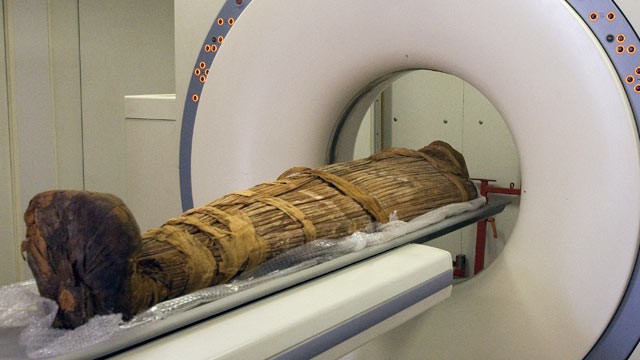
Mummies and atherosclerosis
Researchers
have found hardened arteries after scanning mummified bodies, some of which
were more than 3,000 years old. A more modern diet and lifestyle were once
thought to be the causes of heart disease, but a new study recently published
in the journal The Lancet may prove
otherwise.
![]() |
|
The
mummy Hatiay is scanned in Cairo, Egypt, where it was found to have evidence of
extensive vascular disease by CT scanning. (Dr.
Michael Miyamoto/AP Photo)
|
NPR’s Audie Cornish talks to cardiologist Randall Thompson, one of
the study's authors, about the findings (here)
Original
paper citation is below, as well as a related article.
Thompson, R.C., Allam, A. H., Lombardi, G. P., Wann, L. S., Sutherland, M. L., Sutherland,J. D., ... & Thomas, G. S. (2013). Atherosclerosis across 4000 years of
human history: the Horus study of four ancient populations. The Lancet. Volume
381, Issue 9873, Pages 1211 - 1222
Heagerty, A.M. (2013). Scanning ancient history for evidence of modern diseases. The Lancet. Volume
381, Issue 9873, Pages 1165 - 1166
Some recent interviews of interest to biologists
There have been two good interviews on NPR "On Point" in the last week. The first (here) is with E.O. Wilson (who visited CCS 2 years ago) as he talks about his new book, "Letters to a Young Scientist"
The second (here) about some of the most incredible creatures on the planet. The interview is with Caspar Henderson, writer and environmental journalist. His new book is “The Book of Barely Imagined Beings: A 21st Century Bestiary.”
Monday, May 13, 2013
"What The Vampire Said To The Horseshoe Crab: 'Your Blood Is Blue?'"
When we talked about the oxygen-carrying molecule, hemoglobin, that is present in most animals, we also mentioned that some, instead have hemocyanin, which causes the blood to be blue when oxygenated. Check out this NPR story about the amazing things being learned about the properties of this blood in horseshoe crabs:
and this PBS video, "Blue Blood at $15,000 a quart"!
Labels:
blood,
Circulation,
Invertebrates,
Respiration
Repost: Swim bladders and the "Barry White of the Sea"
Here is the link to the NY Times story
I mentioned in class on vocalizations made by fish
using their swim bladders. The article highlights several cases in
which obnoxious noises were assumed to be anything BUT made by fish and
those who suggested fish as the culprits were called crazy! As I
mentioned the swim bladder is thought to be evolutionarily homologous to
the early lung and both develop as outpockets of the gut (in the early
stages of development). A paper by Zheng et al., published in 2011 in PLoSONE
looks at some of the evidence for the "homolog" idea, and their results
"provide molecular evidence of the relatedness of the fish swimbladder
and mammalian lung."
Here also is the link to some of the cool sounds fish make, including the "Barry White of the sea", the black drum.
And one more link: this one describing research by SFSU professor Roger Bland on the vocalizations of the toadfish in SF Bay.
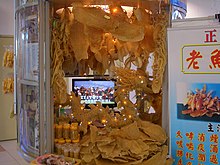
And one more thing about swim bladders.... Some people eat them. From Wikipedia: "In some Asian cultures, the swim bladders of certain large fishes are considered a food delicacy. In China they are known as fish maw, èŠ±è† /鱼鳔, and are served in soups or stews. Swim bladders are also used in the food industry as a source of collagen. They can be made into a strong, water-resistant glue, or used to make isinglass for the clarification of beer.
Swim bladder display in a Melaka shopping mall"
![]() |
| Black drum |
Here also is the link to some of the cool sounds fish make, including the "Barry White of the sea", the black drum.
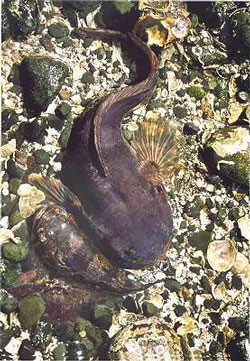
And one more link: this one describing research by SFSU professor Roger Bland on the vocalizations of the toadfish in SF Bay.
![]() |
| Toadfish |
And one more thing about swim bladders.... Some people eat them. From Wikipedia: "In some Asian cultures, the swim bladders of certain large fishes are considered a food delicacy. In China they are known as fish maw, èŠ±è† /鱼鳔, and are served in soups or stews. Swim bladders are also used in the food industry as a source of collagen. They can be made into a strong, water-resistant glue, or used to make isinglass for the clarification of beer.
Swim bladder display in a Melaka shopping mall"
Repost: Why Giant Bugs Once Roamed the Earth
We've talked a bit about gigantic dragonflies found in the fossil
record from the Carboniferous period. I mentioned that a
recent study on oxygen limitation in insects suggests that the leading
theory about these giant arthropods - that they got big because the
high levels of O2 made it possible - may not be correct. Interestingly
they propose that young insects HAD to grow large to avoid oxygen
poisoning.
Read more here (the National Geo article, which is also the source of the photo above). The original research article by Verberk and Bilton in PLoS ONE is here.
Verberk WCEP, Bilton DT (2011) Can Oxygen Set Thermal Limits in an Insect and Drive Gigantism? PLoS ONE 6(7):
Read more here (the National Geo article, which is also the source of the photo above). The original research article by Verberk and Bilton in PLoS ONE is here.
Verberk WCEP, Bilton DT (2011) Can Oxygen Set Thermal Limits in an Insect and Drive Gigantism? PLoS ONE 6(7):
Labels:
Animal physiology,
Evolution,
Invertebrates,
Respiration
Thursday, May 9, 2013
Repost of some apnea
Static apnea is floating face down in a swimming pool
whilst holding your breath is quite possibly the most boring sport in the
world to watch (it makes cricket look exciting) but physiologically
quite interesting. For example divers now use glossopharyngeal insuffation - this is a
method of pumping additional air into the lungs widely used by reptiles
and amphibians (picture a frogs bulging neck) but not by humans. Until a
few decades ago when free divers discovered that by using the tongue as
a piston an additional liter or so of air can be forced into the lungs.
Don't try this at home though, rupturing the lung is a real possibility
unless you work up to it.
How long can you hold your breath? A minute? A minute and a half?
What do you think the world record is. Four minutes? Five minutes? Ten minutes? Think again. The static apnea record is ELEVEN AND A HALF MINUTES!
Curiously the techniques involved don't involve keeping the brain alive without oxygen, that's simply not possible, but getting oxygen to the brain even though you aren't breathing.
If you breath oxygen beforehand though the record is much longer - two people have now exceeded TWENTY MINUTES.
(Here's a challenge - using knowledge of physiology and physics could you predict that the record would be almost twice as long using pure oxygen compared to the ~20% oxygen in air?)
Free diving is much more challenging because you must perform physical exercise without breathing (and face the changing pressure at depth.) There are all sorts of categories including 'no limits' where divers use a weighted sled to pull them down and then air bags to ascend. You still have to hold your breath of course... The world record for this is an amazing 214m (over 700 feet). But the purest form of the sport is where the diver swims down and back under his own power without even the benefit of fins. Watch this amazing dive by William Trubridge, who has set further records since this video - currently his record is an amazing 101m. I love how calm and collected he is. Every movement seems perfectly choreographed and he is clearly maximizing efficiency and not speed.
How long can you hold your breath? A minute? A minute and a half?
What do you think the world record is. Four minutes? Five minutes? Ten minutes? Think again. The static apnea record is ELEVEN AND A HALF MINUTES!
Curiously the techniques involved don't involve keeping the brain alive without oxygen, that's simply not possible, but getting oxygen to the brain even though you aren't breathing.
If you breath oxygen beforehand though the record is much longer - two people have now exceeded TWENTY MINUTES.
(Here's a challenge - using knowledge of physiology and physics could you predict that the record would be almost twice as long using pure oxygen compared to the ~20% oxygen in air?)
Free diving is much more challenging because you must perform physical exercise without breathing (and face the changing pressure at depth.) There are all sorts of categories including 'no limits' where divers use a weighted sled to pull them down and then air bags to ascend. You still have to hold your breath of course... The world record for this is an amazing 214m (over 700 feet). But the purest form of the sport is where the diver swims down and back under his own power without even the benefit of fins. Watch this amazing dive by William Trubridge, who has set further records since this video - currently his record is an amazing 101m. I love how calm and collected he is. Every movement seems perfectly choreographed and he is clearly maximizing efficiency and not speed.
Wednesday, May 8, 2013
It was 60 years ago (next year)
59 years ago yesterday Roger Bannister, a medical student at Oxford University in England, became the first person to run a mile in under 4 minutes.
Which makes a reasonable segue to our physiology section. What many people don't know is that Bannister went on to a distinguished career as both a scientist and a doctor.
On the 50th anniversary of running the sub-4-minute mile, Bannister was interviewed by the BBC's sports correspondent Rob Bonnet. At the conclusion of the interview, Bannister was asked whether he looked back on the sub-4-minute mile as the most important achievement of his life. Bannister replied to the effect that no, he rather saw his subsequent forty years of practising as a neurologist and some of the new procedures he introduced as being more significant.
Tuesday, May 7, 2013
My Pet Camel Spider
| His name is Wilhelm. |
Although camel spiders (also known as wind scorpions or sun scorpions) can grow to up to 6 inches in length, they are rarely dangerous to humans and the myths you may have heard about them aren't true: they don't eat the stomachs of camels, scream while they run at you, or bite off chunks of peoples' flesh while they sleep. During the Iraq war, soldiers would often pit camel spiders against scorpions or other creepy-crawlies for amusement, and place bets on the outcome. They actually aren't scorpions at all; they belong to the order Solifugae, a sister order of both scorpions and spiders.
Camel spiders can run at up to 10 mph, about one third as fast as the fastest human sprinter; they are aggressive and will attack and subdue prey three times their own size. Their large chelicerae can cut through the bone of small animals, and they often use them to make a rattling noise. Although they aren't venomous, their bite is very painful. My solpugid's legs are quite long in proportion to his body size, so I think he is a male, although I haven't been able to get a close enough look at his chelicerae to see if they have the distinctive flagella at the ends. Their first pair of legs are actually pedipalps (similar to a tarantula's), and are used in feeding, fighting, and as sensory organs. They also feature eversible suction cups that allow the camel spider to climb vertical surfaces (I found this out to alarming effect). Camel spiders are visual hunters, with sophisticated central eyes that bridge the gap between simple ocelli and the compound eyes of true insects, like bees or dragonflies.
Most people who come into contact with them are terrified, but I found this testament from a soldier named Nicole, who was stationed in Afghanistan and kept one as a pet:
"I really hate to be the only one not perpetuating all the hype about Camel Spiders, but as you can see from my pictures they are really not that bad. They are like any other creature and can be very tame. I had this one for about six months while I was in Afghanistan. She was quite beautiful and sweet. They are not poisonous, but their bite does hurt very badly and tends to get infected due to lack of hygiene in the areas they are usually encountered. I was never bitten, but it did take a while to calm her down enough to be able to hold her. I never saw her jump or run in six months. She would let me pet her and hold her for hours. I loved my camel spider even though most thought I was crazy…I miss her and wish I could have brought her home with me."
By all accounts, camel spiders are difficult to keep in captivity; we got two a couple of weeks ago for my invertebrate lab and so far only one has held on. This is in part because camel spiders will only eat live prey. Wilhelm eats pinhead crickets, which are about 1/3 his size, every other day; he holds perfectly still until a cricket approaches, and then attacks and consumes his prey in under 30 seconds.
Although most people believe camel spiders live only in the deserts of the Middle East, several species are native to the Southwestern U.S. and Mexico, where they are called "matevenados" (deer killers). We have one species here in Santa Barbara, and it's usually found in arid regions up in the mountains, although I found mine roaming the bank of Atascadero Creek, pretty close to campus. Come talk to me if you have any questions or want to see him; I'm trying to keep him alive until the end of the quarter!
Sunday, May 5, 2013
Irresponsible Bird Flu Research in China
In China, the recent outbreak of bird flu, H7N9, has been a growing threat, infecting 127 people so far. Research from a Chinese lab has received much criticism for conducting "appallingly irresponsible" experiments which combined human and bird flu strains. This article from NYDailyNews describes what has been going on in China.
Controversial bird flu research by Chinese scientists called ‘appallingly irresponsible’
Saturday, May 4, 2013
Wildfire In Ventura
As most of you have probably already heard, there has been a raging wildfire in Ventura County for the past two days. Approximately 2,800 acres have been burned, and 4,000 homes threatened. The Santa Ana winds have encouraged the spread of fire, but forcasted precipitation and cool ocean winds could help get fire under control. Officials are calling it Springs Fire, because it is starting before the normal fire season which normally begins in late summer. Reports say that this one is one of more than 680 wildfires in California so far this year, which is about 200 more than average. CNN meteorologist Chad Myers states that mountain chaparral and shrubs are dry because Los Angeles has received only half of its normal rainfall the past two years. Before people were settled in this area, these wildfires would have raged uncontrollably; however, now that humans live in these regions, fires are being suppressed, perhaps causing the ones that start to be more drastic.
Sunday, April 28, 2013
Orcas and Sea Otters
Here's the paper we were discussing in class week about orca predation on sea otters. It attributes this unique predator-prey relationship to anthropogenic factors and relates to the collapse of Steller's sea lion and harbor seal populations along the west coast of North America. A corresponding decrease in populations of sea birds has been observed, pointing to a reduction in important prey (and commercial) fish populations. It's a fascinating example of the effect that "uncommon and transient species can have in controlling community structure," in a top level predator.
http://www.sciencemag.org/content/282/5388/473.full
Wednesday, April 24, 2013
Real-life faries?
I found this article on Yahoo today that was discussing a new type of insect which they appropriately named Tinkerbell nana after its feather-like, fringed wings. This fairyfly is tiny, only about .0005 inches in length when its full grown but it is very helpful in farms and other agricultural areas because it feeds off the eggs and larvae of insects. The link below has the rest of the article and couple pictures of the fly which are pretty interesting.
http://news.yahoo.com/fairy-insect-mind-blowingly-small-130212512.html
Tuesday, April 23, 2013
Ant careers

From the journal Nature this week:
Tracking whole colonies shows ants make career moves
Comprehensive tagging reveals workers switch tasks as they age. Computer tracking of tagged ants demonstrated that workers divided into three specialized groups — but often switched groups as they aged.
Monday, April 22, 2013
TB cases from early Neolithic period
Rib Lesions in Skeletons From Early Neolithic Sites in Central Germany: On the Trail of Tuberculosis at the Onset of Agriculture
Sunday, April 21, 2013
Using Differential Equations for Population Ecology
In class, we covered exponential and logistic growth; however, systems of differential equations is an approach to model population growth with two species, often referred to as Lotka Volterra Predator-Prey models.
You start with two equations:
- the rate of change in population of the predator with respect to time as a function of the populations
- the rate of change in population of the prey with respect to time as a function of the populations
You then form a matrix representation of the functions and find the eigenvalues and eigenvectors, which are used to plot a phase diagram (a graphical representation of the solution to the differential equations). The magnitude and sign of the eigenvalues determine the stability of the fluctuations between the populations of the two species and the rate of growth of each population. Of the several different possibilities for the phase diagrams, there are two relevant situations: concentric circles, or saddle point.
A saddle point is unstable and suggests the extinction of one of the populations, as shown below.
This is a topic that was covered in Math 4B, but you can also read about it here.
Bio Engineered Organs
Organ transplants have always been a tricky business, first you have to find a viable match for the person who needs it and then there is always the chance of rejection. Scientists have dreamed of building organs in a lab but generating the structure of a working organ has always been a tricky prospect. However due to a recent study at Harvard this dream is becoming more real. Scientists have successfully stripped a cadaver rat kidney of all native cells leaving only and cellular matrix of the kidney and have successfully implanted the
hosts cells and grew an functional kidney which was later successfully implanted in the host rat.
Article
hosts cells and grew an functional kidney which was later successfully implanted in the host rat.
Article
Subscribe to:
Posts (Atom)