Friday, November 28, 2008
PhD
I love Thanksgiving. As a foreigner I'm hardly expected to return home for the occasion, and as a holiday it has few expectations (especially if you observe Buy Nothing Day). So basically I get a really nice long weekend to catch up on stuff. I'm on my third book of the weekend, the third chapter of a textbook I'm reviewing and in between those endeavors I am catching up on a few websites I'd bookmarked to explore in more detail when I had time. One of these, that admittedly I bookmarked a long time ago, was Erik Ringmar's blog. Ringmar was a lecturer at the prestigious London School of Economics (or LSE), who got into trouble for his blog when he fairly openly criticized the school. The article in question, a report of an open day address, is actually rather refreshing for its honesty and hardly seems that critical to me. In a similar vein I found this post, of advice to prospective PhD students, to be worthy of mention. Do read right to the end though....

Thursday, November 27, 2008
Bren events next week
 I hope you all had a good Thanksgiving. Don't forget tomorrow is Buy Nothing Day:
Now in its 17th year, Buy Nothing Day is celebrated every November by environmentalists, social activists and concerned citizens in over 65 countries around the world. Over the years, Buy Nothing Day (followed by Buy Nothing Christmas) has exploded into a global movement, inspiring the world’s citizens to live more simply and buy a whole lot less.
On a slightly related note, the Bren school of Environmental Science and Management has two environmentally themed seminars next week:
Tuesday, Dec. 2, 200812:30 - 1:30 p.m. in Bren Hall 1414
Professor Ramprasad Sengupta
Centre for Economic Studies and Planning, Jawaharlal Nehru University , New Delhi , India
High Economic Growth, Equity, and Sustainable Energy Development of India.
Wednesday, Dec. 3, 2008 4:00 - 5:00 p.m. in Bren Hall 1424
Miriam Haran, PhD
Former Director General, Israeli Ministry of the Environment Head, MBA Environmental Management Program Ono Academic College Kiryat Ono, Israel
Financial Meltdown Does not Slow Global Warming: The Environment in Israel
Monday, November 24, 2008
Anniversary-ish
The website 'On this day in peace history' is noting today (Nov 24th) as the 149th anniversary of the publication of Charles Darwin's 'On the Origin of Species by Means of Natural Selection, or The Preservation of Favoured Races in the Struggle for Life.' Wikipedia, citing a Darwin biography by Adrian Desmond, has it going on sale on the 22nd of November (and selling out almost instantly). A random sampling of a couple of other websites suggests Wikipedia may be correct. Of greater certainty is the fact that in just a few short months, on February 12th, it will be the bicentennial of the birth of Charles Darwin. What better way to pre-celebrate Valentine's day? (Except by listening to the promising and bizarre combination of Patti Smith and Phillip Glass celebrating the work of Allen Ginsburg in Campbell Hall).
In honor of this possible anniversary (or not), enjoy these YouTube clips. You've probably seen the first one. The second one won a lot of advertising awards. Both of them misrepresent evolution in several important ways but that's part of the fun.....
In honor of this possible anniversary (or not), enjoy these YouTube clips. You've probably seen the first one. The second one won a lot of advertising awards. Both of them misrepresent evolution in several important ways but that's part of the fun.....
Coral reef seminar today
EEMB Seminar speaker today is EEMB's own Nichole Price.
Nichole is giving her PhD exit seminar:
"Processes structuring benthic communities on a coral reef".
4pm, Monday, in the MSRB Auditorium.
Saturday, November 22, 2008
Dumb eco-questions you were afraid to ask
 Not directly CCS Biology related but since sustainability is the theme du jour I thought I'd post this here in the hope that somebody might learn something. At UC Berkeley I worked with a lot of students on recycling projects as they investigated an interesting variety of topics from the economics of single stream versus mutliple stream recycling to the contribution of the homeless to the recycling industry. The message I came away with is that recycling is a complicated, constantly changing and sometimes counter intuitive industry.
For example single stream recycling (where all recycling is collected in one bin) is becoming increasingly popular because collection costs are lowest and new technology allows some quite efficient sorting of materials at the depot. However recycling agencies discovered that the less restrictive you make the instructions - the more you collect. ie if you say 'All plastics' you collect a lot more (of ALL kinds of plastics) than if you say only 'Plastics #1 and #2' and if you say something like 'Only #1PETE and #2HDPE blow molded plastic jugs and bottles' you collect least of all because people get confused and end up chucking a lot more in the garbage. But the truth is that in many areas there is ONLY a market for the aforementioned #1 and blow molded#2. So they collect everything but then end up chucking away everything else so that they can get more of #1 and #2. Confused? Try persuading your friends that in most cases they are better off throwing away plastics (at least of #3 and greater), even if their recycling company collects them, because putting them in the recycling devalues the value of the recycling.
This does differ a bit from place to place and depends on your local collection agency and what the local market is for recycling products. I was reminded of this because New Scientist had an article this week on 'Dumb eco-questions you were afraid to ask' that covers a few of these recycling issues. Including the popular, and much debated pizza box question. I'm not sure why they call them dumb though, most of these are pretty good questions.
Coincidentally Popular Mechanics had an article on 'Recycling Myths: Popular Mechanics Debunks 5 Half Truths about Recycling' this month which contains some useful ecomomic information about the recycling industry.
Thursday, November 20, 2008
What is Science?
Bruce pointed out this excellent set of webpages from a geology class at the University of Georgia on 'What is Science?'
There are six separate pages (plus some extras) and each is an entertaining and informative read.
There are six separate pages (plus some extras) and each is an entertaining and informative read.
Tuesday, November 18, 2008
CCS Biology Colloquium Resources available outside the Biology Departments
The following is an incomplete list of resources available for research purposes outside of MCDB and EEMB, both on campus and otherwise in Santa Barbara.
AT UCSB
Anthropology
Anthro has a teaching/reference collection of skeletal material of vertebrates that is largely focused to the interpretation of human habitation sites, but the collection and associated courses can be invaluable to students interested in questions of hard-part anatomy of vertebrates.
Biomolecular Science and Engineering (BMSE)
The Interdepartmental Graduate Program in Biomolecular Science and Engineering epitomizes the highly interdisciplinary approach to research and education that is the hallmark of UC Santa Barbara. In this context BMSE offers a unique mix for graduate training and research at the frontiers of Biochemistry, Molecular Biology, Bioengineering and Biomolecular Materials. The BMSE Program may be for graduates, but an examination of Faculty research pages will lead you to some laboratories working on the forefront of materials and nano-technology where you might find a research option. See particularly:
The Bren School of Environmental Sciences and Policy
The Bren School is technically a graduate program. However, there are some good biological folk there, and if you can talk your way in, so much the better:
Environmental Studies
Department of Earth Science
The department has several mass spectrometric facilities focused upon paleoclimatology recorded by isotopes of Carbon, Oxygen, strontium and others. These isotopes can be used to track other things too. The Paleontological Collections. Ostensibly part of the Museum of Systematics and Ecology, but housed in PSB South. Largely focused upon invertebrate fossils, particularly of the last 60 million years of southern California.
Geography
Extraordinary strengths in remote sensing; both in the use of existing technology and the development of new technologies. Very important for any research involving widespread geographic coverage.
Psychology
The Evolutionary Psychology program has strong ties to the Neurobiology Research Institute. People include:
Beyond standard library resources, UCSB hosts the "Map and Imagery Library" (MIL) in the first floor of the SEL wing. This is a national repository, and has both digital and paper images of just about any kind of geographic reference you could want. This includes:
The Marine Science Institute
The Marine Science Institute (MSI), established at the University of California, Santa Barbara in 1969, is the focus for marine, coastal zone, and freshwater research; marine policy studies; and educational outreach in marine science. MSI administers and supports research projects involving faculty, professional researchers, technical staff, graduate students, and undergraduate students from 14 disciplines. There are a LARGE number of researchers associated with the MSI who are not faculty in one of the biology departments – and many are very student friendly. Some specific faculty to check out include :
Tom Dudley, Jenny Dugan, Mark Page, Uta Passow, Dan Reed, and Milton Love (See especially Milton Love’s web page – it’s cool!). A complete list of MSI associated faculty can be found here.
PISCO (Partnership for Interdisciplinary Studies of Coastal Oceans) is a large, long-term, ecosystem research and monitoring program that involves Santa Barbara and three other West Coast campuses (Oregon State, Stanford and UCSC).
Center for Bioengineering
The Center for BioEngineering (CBE) is a hub for research and teaching at the interface of biology, engineering and physical sciences. It builds on UC Santa Barbara’s strengths in biophysics, biomaterials, biomolecular discovery, and computational and experimental systems biology, enabling fundamental scientific discoveries to be transitioned to applications in medicine and biotechnology.
Cheadle Center for the Study of Biodiversity and Ecosystem Restoration (CCBER)
Located under the south end of the stadium. Used to be the Museum of Systematics and Ecology in EEMB, now independent. Houses the plant and animal collections of the University. Hosts a range of research projects, particularly concerning biodiversity and the reclamation of local ecosystems. Very strong programs in outreach to local school children. Check out their internships.
National Center for Ecological Analysis and Synthesis (NCEAS)
An outstanding international think tank on anything ecological and a lot evolutionary. It is a cross road of visiting scientists, in house researchers and periodic work groups who have access to a series of immense computerized databases that allow researchers to seek out explanations for gross patterns in Nature. Many UCSB faculty and graduate students participate, and there are frequent opportunities to work as paid data-collectors or enterers. NCEAS is located on State Street, in the center of the Paseo Nuevo. Note that they have a Thursday lunch seminar that hosts internationally known scholars.
The UC Natural Reserve System.
The UC System is unusual (not quite unique) in owning its own set of natural reserves dedicated to instruction and research. Each reserve is selected as representative of an important ecosystem in California. Most are managed by resident scientists. All are available for visitation or research with proper initial approval (signing of waiver forms indicating respect of the property, etc. ). Each Reserve has its own web site, and most list past research conducted on the Reserve. A good way to see who is doing what.
UCSB has one on campus (Coal Oil Point Note particularly here that Cristina Sandoval (director of Coal Oil Point) is an active researcher who interacts with undergrads) and two nearby (Sedgwick Reserve & Carpinteria Salt Marsh). We also manage the Santa Cruz Island Reserve, the Kenneth S. Norris Rancho Marino Reserve near Cambria, the Sierra Nevada Aquatic Research Lab in Bishop, and the Valentine Camp on the eastern face of the High Sierra.
OFF CAMPUS
Channel Islands National Park (And the Channel Islands National Marine Sanctuary)
The National Park Service manages several of the Channel Islands, and is interested in supporting research on them. Most of their voucher specimens come to Museum of Natural History
Lotusland Botanic Garden
Located in Montecito, Lotusland occupies 38 acres, much planted with exotic plant species in striking array. Lotusland has the world's third largest collection of cycads, and outstanding collections of Agave, Aloe and cool-tolerant palms. The garden is looking to become increasingly involved in research.
Santa Barbara Botanic Garden
Nearly a century old, the garden focuses upon native Californian plants. It has an outstanding living collection arranged by habitats, and a good library and herbarium focused in native flora. The Garden has a long-standing reputation for research into native Californian plants, and the biogeography of the Channel Islands. Research students interested in botany would do well to explore this. The Garden has a long-standing reputation for research into native Californian plants,
( and https://www.sbbg.org/conservation-research/black-holes-blog) and the biogeography of the Channel Islands.
Santa Barbara Museum of Natural History and Sea Center.
The Museum of Natural History is likewise nearly a century old, and has an established research reputation. It has internationally-recognized collections of living Mollusca and bird egg shells, and a very strong collection of marine invertebrates of the Santa Barbara Channel. Other collections include an excellent collection of mammals, particularly marine mammals, of southern California, a wide range of fossil whale material, a decent insect collection, and collections of particularly Pleistocene fossil marine and terrestrial organisms. It hosts active researchers working on -
Marine Mammals - Krista A. Fahy, Michelle L. Berman
Marine octopods - F. G. Hochberg
Marine gastropods - Henry Chaney
Marine Mollusca - Paul Valentich Scott
Ethnobotany - Jan Timbrook,
Vertebrate Biology - Paul Collins, Patricia Sadeghian
Vertebrate Paleontology - Jonathan Hoffman
Invertebrate zoology (gastropods) - Daniel Geiger
Santa Barbara Zoological Gardens
The Zoo is mostly dedicated to the culture and reproduction of living, endangered, taxa. However, while they might not take kindly to dissecting a living animal, they certainly offer opportunities to examine behavior, and who knows what else might be worked out.
USC Wrigley Marine Science Center, Catalina Island
For those of you with marine interests, a local (SoCal) resource is the Wrigley Marine Science Center on Catalina island, run by USC. It offers research opportunities and summer courses.
AT UCSB
Anthropology
Anthro has a teaching/reference collection of skeletal material of vertebrates that is largely focused to the interpretation of human habitation sites, but the collection and associated courses can be invaluable to students interested in questions of hard-part anatomy of vertebrates.
- Amy Boddy - evolution, genomics, comparative genomics, human biology, evolutionary medicine, fetal-maternal conflict, life history theory, cancer
- Michelle Brown - primate behavioral ecology, evolution of social systems, competition and cooperation, evolutionary game theory, behavioral endocrinology
- Steven Gaulin – Evolutionary psychology
- Mike Gurven - human social behavior and life history evolution
- Amber Vanderwarker - Ethnobotany and zooarcheology
Biomolecular Science and Engineering (BMSE)
The Interdepartmental Graduate Program in Biomolecular Science and Engineering epitomizes the highly interdisciplinary approach to research and education that is the hallmark of UC Santa Barbara. In this context BMSE offers a unique mix for graduate training and research at the frontiers of Biochemistry, Molecular Biology, Bioengineering and Biomolecular Materials. The BMSE Program may be for graduates, but an examination of Faculty research pages will lead you to some laboratories working on the forefront of materials and nano-technology where you might find a research option. See particularly:
- Cherie Briggs (EEMB)
- Deborah Fygenson (Physics)
- Jean Carlson (Physics)
- Dan Morse (MCDB)
- Megan Valentine (Mechanical Engineering)
The Bren School of Environmental Sciences and Policy
The Bren School is technically a graduate program. However, there are some good biological folk there, and if you can talk your way in, so much the better:
- Kelly Caylor (Ecology and hydrology of dry lands)
- Frank Davis (Biogeography, plant ecology)
- Ben Halpern (Marine Ecology and conservation)
- Patrica Holden (Microbial Ecology),
- Bruce Kendall (Modeling and quantitative ecology of plant and animal populations)
- Ashley Larsen (Ecology of managed systems)
- Hunter Lenihan (Restoration ecology, marine ecology)
- John Melack (Aquatic systems)
Environmental Studies
- Carla D'Antonio is interested in invasive plants and general questions of plants in the human sphere - and is a neat person.
- Oliver Chadwick – Soils
- Jordan Clarke – Hydrology
Department of Earth Science
The department has several mass spectrometric facilities focused upon paleoclimatology recorded by isotopes of Carbon, Oxygen, strontium and others. These isotopes can be used to track other things too. The Paleontological Collections. Ostensibly part of the Museum of Systematics and Ecology, but housed in PSB South. Largely focused upon invertebrate fossils, particularly of the last 60 million years of southern California.
- Bruce Tiffney – Paleobotany
- Stan Awramik – Origin and early history of life, astrobiology
- Susannah Porter – Origins of animals, invertebrate paleontology
- Andre Wyss – Vertebrate Paleontology, origin of pinnipeds, biogeography
- David Valentine – microbial biogeochemistry
- David Lea - Really a geochemist, but with spectacular abilities with isotopes and CCS friendly.
- Morgan Raven - Biogeochemistry of sulfur
Geography
Extraordinary strengths in remote sensing; both in the use of existing technology and the development of new technologies. Very important for any research involving widespread geographic coverage.
- Susan Cassels - Epidemiology & Mathematical modeling; social network analysis; infectious disease epidemiology.
- Timothy DeVries - Interactions between chemical, biological, and physical processes in the marine carbon cycle, and in feedbacks between these processes and the Earth's climate
- Hugo Loaciaga: Hydrology and Geology
- Ed Keller: Hydrology and Geology
- Keith Clarke: Remote Sensing
- Jennifer King: Biogeochemistry, earth system science, global change, ecosystem ecology
- David Lopez-Carr: Human dimensions of global environmental change
- Joe McFadden: Land-use and land-cover change, biosphere-atmosphere interaction
- Dar Roberts: Remote sensing of vegetation, geology, ecology, and ecophysiology
- David Siegel : Interdisciplinary oceanography investigating physical, biological, optical and biogeochemical couplings on micro to ocean basin scales.
- Anna Trugman: Using plant physiology, integrating field measurements with numerical ecosystem models to gain new insight into the biological processes affecting climate-vegetation interactions.
- Kelly Caylor: Ecology and hydrology of dry lands.
Psychology
The Evolutionary Psychology program has strong ties to the Neurobiology Research Institute. People include:
- Ben Reese (Neuroanatomy)
- Michael Goard (Mammalian neocortical brain function)
- Skirmantas Janusonis (Neuroscience and Behavior)
- Tod Kippen (Neuroscience and Behavior)
- Karen Szumlinksi (Neuroscience and Behavior)
- Ben Reese (Developmental Neurobiology)
- Ikuko Smith (Neuroscience and Behavior)
- Emily Jacobs - how sex steroid hormones shape the neural circuitry underlying higher order cognitive functions
Beyond standard library resources, UCSB hosts the "Map and Imagery Library" (MIL) in the first floor of the SEL wing. This is a national repository, and has both digital and paper images of just about any kind of geographic reference you could want. This includes:
- Topographic maps
- Geologic Maps
- Maps & volumes summarizing vegetation, climate, hydrology, cultural and other features;
- Aerial photographs from landsat down to old plane-flown photographs.
- And much more!
The Marine Science Institute
The Marine Science Institute (MSI), established at the University of California, Santa Barbara in 1969, is the focus for marine, coastal zone, and freshwater research; marine policy studies; and educational outreach in marine science. MSI administers and supports research projects involving faculty, professional researchers, technical staff, graduate students, and undergraduate students from 14 disciplines. There are a LARGE number of researchers associated with the MSI who are not faculty in one of the biology departments – and many are very student friendly. Some specific faculty to check out include :
Tom Dudley, Jenny Dugan, Mark Page, Uta Passow, Dan Reed, and Milton Love (See especially Milton Love’s web page – it’s cool!). A complete list of MSI associated faculty can be found here.
PISCO (Partnership for Interdisciplinary Studies of Coastal Oceans) is a large, long-term, ecosystem research and monitoring program that involves Santa Barbara and three other West Coast campuses (Oregon State, Stanford and UCSC).
Center for Bioengineering
The Center for BioEngineering (CBE) is a hub for research and teaching at the interface of biology, engineering and physical sciences. It builds on UC Santa Barbara’s strengths in biophysics, biomaterials, biomolecular discovery, and computational and experimental systems biology, enabling fundamental scientific discoveries to be transitioned to applications in medicine and biotechnology.
Cheadle Center for the Study of Biodiversity and Ecosystem Restoration (CCBER)
Located under the south end of the stadium. Used to be the Museum of Systematics and Ecology in EEMB, now independent. Houses the plant and animal collections of the University. Hosts a range of research projects, particularly concerning biodiversity and the reclamation of local ecosystems. Very strong programs in outreach to local school children. Check out their internships.
National Center for Ecological Analysis and Synthesis (NCEAS)
An outstanding international think tank on anything ecological and a lot evolutionary. It is a cross road of visiting scientists, in house researchers and periodic work groups who have access to a series of immense computerized databases that allow researchers to seek out explanations for gross patterns in Nature. Many UCSB faculty and graduate students participate, and there are frequent opportunities to work as paid data-collectors or enterers. NCEAS is located on State Street, in the center of the Paseo Nuevo. Note that they have a Thursday lunch seminar that hosts internationally known scholars.
The UC Natural Reserve System.
The UC System is unusual (not quite unique) in owning its own set of natural reserves dedicated to instruction and research. Each reserve is selected as representative of an important ecosystem in California. Most are managed by resident scientists. All are available for visitation or research with proper initial approval (signing of waiver forms indicating respect of the property, etc. ). Each Reserve has its own web site, and most list past research conducted on the Reserve. A good way to see who is doing what.
UCSB has one on campus (Coal Oil Point Note particularly here that Cristina Sandoval (director of Coal Oil Point) is an active researcher who interacts with undergrads) and two nearby (Sedgwick Reserve & Carpinteria Salt Marsh). We also manage the Santa Cruz Island Reserve, the Kenneth S. Norris Rancho Marino Reserve near Cambria, the Sierra Nevada Aquatic Research Lab in Bishop, and the Valentine Camp on the eastern face of the High Sierra.
OFF CAMPUS
Channel Islands National Park (And the Channel Islands National Marine Sanctuary)
The National Park Service manages several of the Channel Islands, and is interested in supporting research on them. Most of their voucher specimens come to Museum of Natural History
Lotusland Botanic Garden
Located in Montecito, Lotusland occupies 38 acres, much planted with exotic plant species in striking array. Lotusland has the world's third largest collection of cycads, and outstanding collections of Agave, Aloe and cool-tolerant palms. The garden is looking to become increasingly involved in research.
Santa Barbara Botanic Garden
Nearly a century old, the garden focuses upon native Californian plants. It has an outstanding living collection arranged by habitats, and a good library and herbarium focused in native flora. The Garden has a long-standing reputation for research into native Californian plants, and the biogeography of the Channel Islands. Research students interested in botany would do well to explore this. The Garden has a long-standing reputation for research into native Californian plants,
( and https://www.sbbg.org/conservation-research/black-holes-blog) and the biogeography of the Channel Islands.
Santa Barbara Museum of Natural History and Sea Center.
The Museum of Natural History is likewise nearly a century old, and has an established research reputation. It has internationally-recognized collections of living Mollusca and bird egg shells, and a very strong collection of marine invertebrates of the Santa Barbara Channel. Other collections include an excellent collection of mammals, particularly marine mammals, of southern California, a wide range of fossil whale material, a decent insect collection, and collections of particularly Pleistocene fossil marine and terrestrial organisms. It hosts active researchers working on -
Marine Mammals - Krista A. Fahy, Michelle L. Berman
Marine octopods - F. G. Hochberg
Marine gastropods - Henry Chaney
Marine Mollusca - Paul Valentich Scott
Ethnobotany - Jan Timbrook,
Vertebrate Biology - Paul Collins, Patricia Sadeghian
Vertebrate Paleontology - Jonathan Hoffman
Invertebrate zoology (gastropods) - Daniel Geiger
Santa Barbara Zoological Gardens
The Zoo is mostly dedicated to the culture and reproduction of living, endangered, taxa. However, while they might not take kindly to dissecting a living animal, they certainly offer opportunities to examine behavior, and who knows what else might be worked out.
USC Wrigley Marine Science Center, Catalina Island
For those of you with marine interests, a local (SoCal) resource is the Wrigley Marine Science Center on Catalina island, run by USC. It offers research opportunities and summer courses.
Monday, November 17, 2008
Foldit
 Foldit is a computer game that was released in May of this year that allows amateurs to compete against, and collaborate with, specialists to design protein structures. Introductory levels teach the general governing concepts that users must understand before moving on to design complicated, potentially useful molecules. This is an interesting example of the potential power of distributed computing. Human brains currently manipulate three dimensional structures much better than computers. It is hoped that by studying how humans solve puzzles better computer algorithms will be devised. The YouTube video below gives a nice overview of the game.
Thursday, November 13, 2008
How flies find stuff.
Next week's EEMB seminar speaker will be Dr. Michael Dickinson, professor of bioengineering at the California Institute of Technology.  Michael's research merges behavioural ecology and bioengineering to study how flies perceive and navigate their environment. His work (and talks) are very exciting and has resulted in his being awarded a prestigious MacArthur Foundation prize (a very big deal). For more information on Michael's research, check out his page at Caltech.

This talk will be on Monday at 4pm in Psych 1924 (note venue change).

I have heard Michael talk many times and can assure you that this will be a great talk. Strongly recommended for all, regardless of your interest in flies, flight or stuff.
Wednesday, November 12, 2008
Reef fish seminar
I would like to announce the following invited research seminar by Dr Michel Kulbicki of the University of Perpignan. The seminar will be presented in the main Auditorium of the Marine Science Institute Research Building on Tuesday, November 25th from 4-5PM and is sponsored by the Moorea Coral Reef LTER site.
Michel Kulbicki is based at the Insitut de Recherche pour le Développement in Perpignan, France. He was originally trained in biology and fish ecology at the Institut National d'Agronomie de Paris and Oregon State University. After four years of work on tuna fisheries and echointegration, he came to reef fish ecology in 1985. He was then based in New Caledonia where he worked until 2004. During his stay there, he had the opportunity to conduct fieldwork in New Caledonia, French Polynesia, Tonga and Fiji. His major interests lie in linking the characteristics of reef fish assemblages (e.g. species composition, functional groups, trophic or size structure) to factors at various spatial scales, from local (reef type, fishing pressure, coral cover) to regional (island size, island type, degree of isolation). He is also interested in developing better methods to survey reef fish and in associating information on fish obtained via underwater visual censuses with information on the environment obtained via remote sensing.
Seminar Title: Macro-ecology and understanding the large scale functioning of reef fish assemblages in the Pacific
Abstract: The regional species and functional diversity of reef fishes determines to a significant extent the local species and functional diversity of these fishes in the Pacific. As regional diversity is related to large scale factors such as island size and connectivity, distance to the biodiversity center, latitude, these factors also play a role on the distribution and composition of local reef fish diversity. Amongst the life history traits, (adult) size follows gradients linked to island size and connectivity. Species range is also found to be correlated to species (adult) size and larval duration and is also correlated to island size and connectivity. Colonizing ability can be as well related to (adult) size (finding mates, reproductive capacity, resource limitation). These findings explain why on small isolated islands the proportion of large species is higher than on large connected islands in the Pacific. One of the major consequence is the shape of the diversity-biomass relationship which presents a steeper slope on small isolated islands but reaches lower values of biomass because of lower diversity. The implications for management are important, in particular this shows how small islands will be far more fragile to fishing than larger or well connected islands. These findings may find applications in other systems where "ecological islands" exist.
Michel Kulbicki is based at the Insitut de Recherche pour le Développement in Perpignan, France. He was originally trained in biology and fish ecology at the Institut National d'Agronomie de Paris and Oregon State University. After four years of work on tuna fisheries and echointegration, he came to reef fish ecology in 1985. He was then based in New Caledonia where he worked until 2004. During his stay there, he had the opportunity to conduct fieldwork in New Caledonia, French Polynesia, Tonga and Fiji. His major interests lie in linking the characteristics of reef fish assemblages (e.g. species composition, functional groups, trophic or size structure) to factors at various spatial scales, from local (reef type, fishing pressure, coral cover) to regional (island size, island type, degree of isolation). He is also interested in developing better methods to survey reef fish and in associating information on fish obtained via underwater visual censuses with information on the environment obtained via remote sensing.
Seminar Title: Macro-ecology and understanding the large scale functioning of reef fish assemblages in the Pacific
Abstract: The regional species and functional diversity of reef fishes determines to a significant extent the local species and functional diversity of these fishes in the Pacific. As regional diversity is related to large scale factors such as island size and connectivity, distance to the biodiversity center, latitude, these factors also play a role on the distribution and composition of local reef fish diversity. Amongst the life history traits, (adult) size follows gradients linked to island size and connectivity. Species range is also found to be correlated to species (adult) size and larval duration and is also correlated to island size and connectivity. Colonizing ability can be as well related to (adult) size (finding mates, reproductive capacity, resource limitation). These findings explain why on small isolated islands the proportion of large species is higher than on large connected islands in the Pacific. One of the major consequence is the shape of the diversity-biomass relationship which presents a steeper slope on small isolated islands but reaches lower values of biomass because of lower diversity. The implications for management are important, in particular this shows how small islands will be far more fragile to fishing than larger or well connected islands. These findings may find applications in other systems where "ecological islands" exist.
Monday, November 10, 2008
Seminar this evening
If your days are just packed then how about an early evening seminar?
Monday evening seminar (tonight) will be presented by Dr. Deborah Gordon from Stanford University. Her talk is entitled:
Ecology and behavior of Argentine Ants in California.
LOCATION: CCBER Classroom at Harder Stadium,
TIME: 6-7 PM
Monday evening seminar (tonight) will be presented by Dr. Deborah Gordon from Stanford University. Her talk is entitled:
Ecology and behavior of Argentine Ants in California.
LOCATION: CCBER Classroom at Harder Stadium,
TIME: 6-7 PM
Sunday, November 9, 2008
Wonders of ocean life counted in massive census
 I'm not sure exactly why this is the lead story on the CNN website right now, slow news day?, but it's good to see some biology there.
A city of brittle stars off the coast of New Zealand, an Antarctic expressway where octopuses ride along in a flow of extra salty water and a carpet of tiny crustaceans on the Gulf of Mexico sea floor are among the wonders discovered by researchers compiling a massive census of marine life.
Saturday, November 8, 2008
Society of Undergraduate Biologists
I already posted this once but I'll give it another shout. Get involved now whilst the club is getting going and you can get in on the ground floor. One moment you'll be a community organizer and the next moment......
Research: SUB will strive to promote undergraduate research as both an essential part of an undergraduate’s education and as an asset to the scientific community. SUB will support those undergraduates already involved and will encourage those still yet to participate. Future goals: Obtaining special funding for undergraduate research; Undergraduate research seminars; Encouraging involvement in undergraduate research; Featuring UCSB research through the org. website and events.
Mentorship: The biology degrees offered by the CCS, EEMB and MCDB departments allow students to explore exciting educational challenges and opportunities. SUB will facilitate a system of mentorship in which undergraduates, throughout all four years of their degree, can look to others for advice in maximizing their experience at UCSB. Future goals: Graduate student-undergraduate student mentorship program; Promotion of departmental peer advisors; Events for incoming freshmen; Study group organization; Grad school admissions seminars. Communication: Science is a group effort. Communication is key. SUB will promote a well-informed undergraduate community by facilitating communication amongst undergraduates, between students and faculty, and between biology departments. Future goals: Promotion of departmental events (seminars, symposia, etc.); Undergraduate science-focused social events; Faculty-student events.
The Society of Undergraduate Biologists (
Research: SUB will strive to promote undergraduate research as both an essential part of an undergraduate’s education and as an asset to the scientific community. SUB will support those undergraduates already involved and will encourage those still yet to participate. Future goals: Obtaining special funding for undergraduate research; Undergraduate research seminars; Encouraging involvement in undergraduate research; Featuring UCSB research through the org. website and events.
Mentorship: The biology degrees offered by the CCS, EEMB and MCDB departments allow students to explore exciting educational challenges and opportunities. SUB will facilitate a system of mentorship in which undergraduates, throughout all four years of their degree, can look to others for advice in maximizing their experience at UCSB. Future goals: Graduate student-undergraduate student mentorship program; Promotion of departmental peer advisors; Events for incoming freshmen; Study group organization; Grad school admissions seminars. Communication: Science is a group effort. Communication is key. SUB will promote a well-informed undergraduate community by facilitating communication amongst undergraduates, between students and faculty, and between biology departments. Future goals: Promotion of departmental events (seminars, symposia, etc.); Undergraduate science-focused social events; Faculty-student events.
Thursday, November 6, 2008
REU site
A couple of the students on Wednesday mentioned the National Science Foundation's Research Experience for Undergraduates program. NSF maintains an extensive website where you can find details of what the REU program is all about and allows you to list the sites by subject or state. The list of sites in the Biological Sciences is impressive. Many (most?) of the REU programs run over the summer so this is early notice of something you may want to consider for next summer.
Wednesday, November 5, 2008
Ecosystem services seminar
THE BREN SCHOOL OF ENVIRONMENTAL SCIENCE AND MANAGEMENT
Presents
Ashok Khosla
Chairman, Development Alternatives Group India President
International Union for Conservation of Nature
Tuesday, Nov. 18, 2008
12:30 - 1:30 p.m.
Bren Hall 1414
"The Importance of Including the Value of Ecosystem Services in Economic Calculations "
Presents
Ashok Khosla
Chairman, Development Alternatives Group India President
International Union for Conservation of Nature
Tuesday, Nov. 18, 2008
12:30 - 1:30 p.m.
Bren Hall 1414
"The Importance of Including the Value of Ecosystem Services in Economic Calculations "
Scientists in Japan clone mice that had been frozen for 16 years
http://www.reuters.com/article/newsOne/idUSTRE4A26NV20081103
They suggest this leads to the possibility of cloning extinct species from the cells of frozen animals like mammoths. I've also heard the idea that being able to clone animals could lead to an ethical meat option for vegans and vegetarians (no animal would be harmed as the meat would be grown by itself in a lab).
They suggest this leads to the possibility of cloning extinct species from the cells of frozen animals like mammoths. I've also heard the idea that being able to clone animals could lead to an ethical meat option for vegans and vegetarians (no animal would be harmed as the meat would be grown by itself in a lab).
Tuesday, November 4, 2008
Go Godwit go
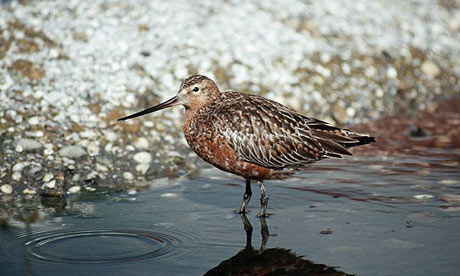 There will always be a place here for the wonders of the biological world. I saw news this week of a report in the Proceedings of the Royal Society detailing the epic migration of the bar tailed godwit using data obtained from individual transmitters on birds. One female flew over 11,000km in a nonstop flight across the Pacific Ocean from Alaska to New Zealand.
 The bird's journey lasted more than eight days with no rest or food, and took it into a place in the record books. The bird would have flapped its wings non-stop for the entire journey and did not feed or sleep. The godwit shown above is, presumably, taking a well earned rest.
Sunday, November 2, 2008
Election day special
Special Seminar:

Dr. Ildikó Somorjai  (postdoc candidate for Smith lab)
Laboratoire Océanologique Université Pierre et Marie Curie Paris VI,
Banyuls-sur-Mer, France

Tuesday November 4th at 11:00, room 3137 Bio2

Title: "On axes and allies: Wnt regulation from flies to amphioxus"
Subscribe to:
Posts (Atom)