Showing posts with label Microbiology. Show all posts

Tuesday, April 18, 2017

Endosymbiosis of the Powerhouse of the Cell

Does anyone else find it entertaining when you mention the mitochondrion during a discussion entirely in context and someone instinctively blurts out "mitochondria are the powerhouses of the cell"? Well, as we discussed just last week, they weren't always the powerhouses of eukaryotic cells. It turns out that the scientific community currently has more questions than answers about when, why, and how endosymbiosis most likely occurred.

Summary of this review paper, entitled "The origin and early evolution of mitochondria"

  • Organism with genetically "richest" mitochondrial genome (most likely resembles ancestral protist that underwent symbiosis) is called Reclinomonas americana
  • Like viruses, mitochondrial genomes underwent "reductive evolution," in which their genomes decreased in size by throwing out genetic information that was redundant within the host cell's genome
  • Genome sequencing alludes to the possibility that ALL mitochondria are derived from a single mitochondrion, meaning that this relationship arose only once in evolution
  • While it is not clear when exactly the mitochondrion entered the eukaryotic cell, the evidence is clear that they primarily evolved together to create the Eukarya domain
  • Mitchondria likely arose from a parasitic intracellular alpha-proteobacteria
While all of this is exciting, the evidence needs to be considered with a skeptical frame of mind. Much of the data to support the claims above came from genome sequencing, and the parts determined to be ancestral to the original mitochondrion may well just be ancestral to the universal common ancestor (for argument can be made that some of the genetic material in the mitochondrion that was considered in these studies have very far relatives in bacteria, archea, and eukarya).

So while it was an interesting read, and I think a lot was learned, not a lot was definitively claimed. But so is science.

Thursday, February 6, 2014

Extremophiles

Going back to our discussion on extremophiles, I thought I’d share some links I found after further research. This animation gave short summaries about some well-known microbes here on Earth, and speculation about some on other planets.

For example, 6 feet below the extremely dry Atacama Desert in Chile, they found microbes living in salt crystals with a slim amount of water that feed on anhydrite and perchlorate. The research team developed an instrument to find the microbes, called SOLID (Signs of Life Detector). Their goal now is to use the instrument to search for life on Mars. Here's the 2012 article in Science Daily with a more in-depth description of the discovery. 

If you’re interested in learning more, here is another more recent discovery of extremophiles in a cavern close to Tucson, Arizona.

Additionally, a side of cuteness: Who doesn’t love an adorable, indestructible microbial bear? Watch it waddle away here.

Sunday, February 24, 2013

Depauperate dental flora

Going back to an earlier class here's a news article from Science this week on two recent papers that describe the origin of our depauperate dental flora:

How Sweet It Is: Genes Show How Bacteria Colonized Human Teeth
When humans invented farming 10,000 years ago, they weren't the only ones to get a boost from the new starchy diet. Some microbes that had lurked at low levels in the mouths of hunter-gatherers bloomed on the sugary films coating the teeth of farmers who munched cereal grains. Eventually the cavity-causing Streptococcus mutans, for one, took root. It adapted to the sweet life, multiplying like a weed and edging out many other species of bacteria. That leaves the modern mouth a depauperate ecosystem, according to two new genetic studies.

Wednesday, February 13, 2013

Donor feces

I've been reading a lot about clinical trials lately. The press tend to make too much out of small effects that may not mean very much and a great many of our drugs, even well known and very popular ones, are little better than a placebo.

In any double-blind clinical trial the results are monitored by an outside body to ensure, for example, that any dangerous side-effect of the drug or treatment, is noticed and the trial can be stopped. In rare instances they also decide the drug, or treatment, is so successful that they also stop the trial so that everyone can benefit. When they do this it's usually a good sign the researchers are onto something big.

That's what happened in one of the first clinical trials of fecal transplants published last month in the New England Journal of Medicine:
Duodenal Infusion of Donor Feces for Recurrent Clostridium difficile

There's a description of the issue and the research at Wired's Superbug blog. They link to an NPR article that describes the work of a Canadian team to come up with synthetic feces called RePOOPulate.


Tuesday, February 12, 2013

Life under ice


In Nature this week:
Lake-drilling team discovers life under the ice
Host of microbes found in lake deep under Antarctica's ice sheet.

The lake in question is a 60-square-kilometre body of water that sits on the edge of the Ross Ice shelf in West Antarctica. To reach it, Priscu, a glaciologist at Montana State University in Bozeman, and his team had to drill down 800 metres of ice.
...
Both water and sediment contained an array of microbes that did not need sunlight to survive. The scientists counted about 1,000 bacteria per millilitre of lake water — roughly one-tenth the abundance of microbes in the oceans. In Petri dishes, the bacteria show a “really good growth rate”, says Priscu.
...

The exact nature of the life unearthed by the US team will now be established by DNA sequencing and other tests. It will take at least a month to do the basic work, says Priscu.

“What we are all dying to find out now is, of course, ‘who’s there’ and ‘what’s their life style',” he says.

Researchers hope that the survival strategies of the subglacial microbes might offer clues to what the biology of extraterrestrial life might be like — Jupiter’s moon Europa, for instance, is thought to host a large sub-surface ocean of water where such life might be able to exist.


As photosynthesis is impossible without sunlight, the Lake Whillans bacteria must get their energy from a different source. This could be existing organic material, or, like the ‘chemotrophs’ found in gold mines and near deep-sea hydrothermal vents, the bacteria might run on chemical reactions involving minerals in the Antarctic bedrock and carbon dioxide dissolved in lake water.

“We have been allowed a glimpse into Antarctica’s subglacial world,” Priscu says. “I’m sure our results will change the way we view that continent.”

Wednesday, January 23, 2013

Strain 121


Vent chimneys with tubeworms on the Juan de Fuca Ridge.
The tops of the chimneys are too hot for animals. 

There's an article about Geogemma barossii, aka Strain 121, at Microbe Wiki but it doesn't contain a lot of information. I found this article at Microbe News Network more interesting. Click for the full article, I've only posted an excerpt.

World’s Hottest Microbe: Loving Life in Hell

Move over, Pyrolobus fumarii. A new entry for the record books has just been discovered. The hottest organism known to man has been isolated from a thermal vent deep in the Pacific Ocean.


The previous record-holder, P. fumarii, could live at temperatures as high as 113 °C (235 °F), well above the boiling point of water. But the new microbe, for now called “Strain 121,” thrives at 121 °C and can even survive for two hours at 130 °C.

The new organism is also unusual because it relies on iron to digest food and produce energy. Such organisms show promise in generating electricity from waste products and in removing radioactive metals from the environment.

“No one had ever seen a bug like this before,” says Derek R. Lovley of the University of Massachusetts in Amherst, who along with colleague Kazem Kashefi reported their discovery in Science. Researchers believe that many high-temperature microbes rely on iron to grow, but none had ever been isolated or cultured until now.

“The trick was to grow it in the presence of iron,” says Lovley. Many underwater structures are rich in metals and the microbes that live there are likely to use things like iron in their metabolism, he says.
...
In addition to their possible use in cleaning up toxic wastes and in generating energy, the microbes may also yield useful substances and pharmaceuticals with commercial and technological applications, such as heat-resistant enzymes that can be used in detergents.

Thursday, January 17, 2013

Blood falls

Blood Alley, Blood Diamond, Blood Red, Blood Simple, Blood Ties, Blood Work, Bloodbrothers, Bloodfist, Bloodline, Bloodsport.

Huh, apparently no-one has ever made a movie called Blood Falls.

The Blood Falls story, that is pictured in your textbook, is highlighted in a news report at the NSF website: Unusual Antarctic Microbes Live Life on a Previously Unsuspected Edge.

The News report was inspired by an article in Science entitled: A Contemporary Microbially Maintained Subglacial Ferrous "Ocean"

An active microbial assemblage cycles sulfur in a sulfate-rich, ancient marine brine beneath Taylor Glacier, an outlet glacier of the East Antarctic Ice Sheet, with Fe(III) serving as the terminal electron acceptor. Isotopic measurements of sulfate, water, carbonate, and ferrous iron and functional gene analyses of adenosine 5′-phosphosulfate reductase imply that a microbial consortium facilitates a catalytic sulfur cycle. These metabolic pathways result from a limited organic carbon supply because of the absence of contemporary photosynthesis, yielding a subglacial ferrous brine that is anoxic but not sulfidic. Coupled biogeochemical processes below the glacier enable subglacial microbes to grow in extended isolation, demonstrating how analogous organic-starved systems, such as Neoproterozoic oceans, accumulated Fe(II) despite the presence of an active sulfur cycle.

Saturday, June 2, 2012

86 million year old lunch box

In a tenuous link to the previous posts on obesity I was drawn to the following news article on NPR:
Ancient Deep-Sea Bacteria Are In No Hurry To Eat

The Science paper the report is based on isn't quite as catchy:
Aerobic Microbial Respiration in 86-Million-Year-Old Deep-Sea Red Clay

 but the observations and the implications are pretty interesting:

They left the surface 86 million years ago with one lunch box, and they're still eating out of it. It's like they're splitting a pie, and they keep splitting in half and in half and in half, but nobody ever eats the last crumble. It's quite remarkable.
... 
One reason scientists are interested in this extreme lifestyle is because it provides clues about the absolute minimum conditions required to sustain life. Andreas Teske, a marine microbiologist at the University of North Carolina, Chapel Hill, says that's useful for people looking beyond our planet for signs of life.

Monday, May 3, 2010

Asphalt volcanoes

And on the topic of geology, check out some of the press on the newest members of the CCS Bio team, Professor Dave Valentine of Earth Sciences , has been getting.

Listen to a report on KCLU: A team of researchers has found a group of what are known as "asphalt volcanoes"...some up to 65 feet high...on the ocean floor off the Santa Barbara County coastline.

Or read about it on the National Geographic website or the NSF website.

This is relevant to biology for several reasons. First, in terms of methane production and the creation of 'dead zones':

Eruptions of the California mounds might have once spewed enough methane to dramatically boost populations of methane-eating marine bacteria.

These bacteria depleted the water's oxygen, creating a giant "dead zone" in the Santa Barbara basin that was lethal to most marine life.

and secondly in terms of creating hard substrates for colonization by living organisms:

Asphalt mounds in general help create environments for marine life that might not otherwise exist.

"Processes that produce hard substrates in the deep ocean are rare. ... Generally speaking, the deep ocean is a muddy place," MacDonald said.

"I think it's really cool that there's this other process that we didn't really know about before that, at least in some places, is making pretty extensive hard bottoms for animals to colonize."

Tuesday, January 20, 2009

Ocean bacterial diversity

Prochlorococcus marinus, a tiny globular cyanobacterium.

A couple of articles about ocean bacterial diversity.

First a report on the 2006 Science paper that suggested marine microbial diversity could be 10 to 100 times greater than previously thought.
"From an evolutionary perspective, they are of pivotal importance. They were the only kinds of life on Earth for approximately 80% of the planet's history. All multi-cellular life depends upon microbial processes. The microbes can live without us but we are totally dependent upon them for our continued survival. Exploration of this newly discovered rare biosphere' could become a major field of marine biology."

The second is more recent and describes the discovery a few months ago of a species of cyanobacteria that appears to have abandoned photosynthesis for a life of Nitrogen fixation.
"For it to have such an unusual metabolism is very exciting. We're trying to understand how something like this can live and grow with so many missing parts."

Monday, May 12, 2008

Pavlov's bacteria

In this week's Science:

Could bacteria learn to match a signal that didn't occur regularly to a probable future event? If so, the bacterium could improve its chances of survival by turning on a preemptive response.

Because E. coli gets warmer when it enters a human mouth and then must soon contend with low oxygen levels as it passes into the large intestine, the team reasoned that the bacterium might use temperature as a cue to prepare for the upcoming lack of oxygen. Indeed, when the researchers turned up the heat in a dish of E. coli, the bugs dialed down activity in genes that normally operate in high-oxygen conditions. But the true test came when the team flipped the normal association, growing the bacteria in conditions in which high oxygen levels followed temperature increases. Less than 100 generations later, the bacteria stopped turning on their low-oxygen response after exposure to high temperatures, suggesting that they had evolved to break the association.

The study is the "first convincing demonstration" that bacteria can use environmental cues to anticipate events, says Michael Travisano, an evolutionary biologist at the University of Minnesota, Twin Cities. The work could open up new ways to explain puzzling behavior of microbial pathogens, which might use predictive signals to change their cell surfaces and avoid a host's impending immune attack.

Tuesday, April 1, 2008

Smashing

In a post relevant to last semesters discussion of the origin of life and the survival of life during severe asteroid impacts I am happy to report that a group of German scientists have been placing bacteria between slabs of rock and then whacking this bacteria-rock sandwich with iron cylinders fired by explosives. This creates pressures up to 500,000 atmospheres and temperatures as high as 1000C simulating the forces during asteroid impacts. Even at the most extreme conditions they found a few individuals survived in two out of three species tested.

The paper, Microbial Rock Inhabitants Survive Hypervelocity Impacts on Mars-Like Host Planets: First Phase of Lithopanspermia Experimentally Tested, is in Astrobiology which you can read as an online journal. This is an interesting journal if you like, well, astrobiology.

Sunday, January 20, 2008

Earthquakes and microbes

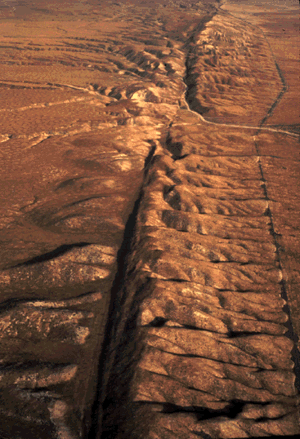
We are finding more and more microbes living deep within the earth's crust. Some of them have been found several kilometers down. A new paper is Astrobiology suggests that earthquakes might be important in supplying the nutrient rich rocks that sustain the bacteria and calculations suggest that seismic events happen regularly enough to sustain microbial life in this way for billions of years.

Thursday, January 10, 2008

Mimivirus

The mimivirus debate is another chunky debate to get your teeth into. There are several hypotheses for where mimiviruses fit in the tree of life and including them as a fourth domain is only one suggestion. The wikipedia article is a good place to start and there's another good Discover article on the story but for something a little meatier try this PNAS paper with the title: 'Three RNA cells for ribosomal lineages and three DNA viruses to replicate their genomes: A hypothesis for the origin of cellular domain.'