So in 7th grade I remember being taught that sponges were "the first group of animals to evolve" - or more aptly put now - the earliest branching animal lineage. This thus made the sponges the sister group to all other animals, and I went on believing this lie for many years. But then my whole life was uprooted when, in CCS bio, John enlightened us to the current interpretation of the tree of life where ctenophores (comb jellies) kicked sponges out of their original position on the tree of life. I was shook. But as I was looking further into this topic after class, I found a recently published paper which discussed a new phylogenetic analysis that took place and restored sponges to their original position on the tree of life. Yay!
The new analysis used a much larger and more robust data set for their phylogenetic analysis than any other previous study tackling the issue - using a set of 1,719 "high quality" genes and 79 species. The researchers found that the most parsimonious interpretation of their results yields a tree of life where sponges branch off first in the metazoans and are monophyletic. These results also remove the implication that neurons and muscle cells had to evolve twice in the animal lineage - once in the ctenophores, then being lost in sponges, and evolving once again in bilaterals - as would have been the case if ctenophores branched first.
Previous phylogenetic analysis studies likely developed a different view of the tree of life due to an artifact or error known as long branch attraction which occurs when organisms with a high rate of molecular evolution, such as ctenophores, are grouped together simply because of this high rate of molecular evolution. This groups lineages that are not necessarily related together and thus produces errors.
If you want to look into this study in greater depth, here is a link to the article: http://www.sciencedirect.com/science/article/pii/S0960982217301999
Wednesday, May 24, 2017

Monday, May 8, 2017
What your parents aren't telling you about weed.
Weed. Marijuana. Mary Jane. Whatever you call it, it's a drug; it comes from a plant; and it can make you high. It's also used as a pain killer. You probably already knew all of this. But what I bet you didn't know is that new research suggests that marijuana may be able to reverse aging!! This is probably because WHO WOULD HAVE THOUGHT and also
because the paper was just published today. Believe it or not, researchers were able to return the state of old mice to that of two-month-old mice with prolonged low-doses of THC. They are now looking to start clinical trials in people. This novel role for marijuana holds exciting possibilities for the development of future treatments for age-related diseases such as dementia. Read the full article at the link below. Crazy stuff man!
https://www.sciencedaily.com/releases/2017/05/170508112400.htm

Tuesday, May 2, 2017
Fancy New Species
Hey guys!
So after Claudia talked about the cool new species in class I did some research to see what else was discovered recently.
My personal favorites are
Lasiognathus Dinema - this is a type of Angler fish living at depths below 500m. The thing that drew me to this was how crazy it looked! I feel like most biologists have an idea of what an angler fish is supposed to look like (especially with movies like Finding Nemo) but check this out!

It was discovered very recently so there aren't really any papers on it, but here's an article talking about its discovery.
Phyllopteryx Dewysea - also known as the Ruby Seadragon. Not only does this look pretty cool since it is related to seahorses, but it is only known from 4 preserved specimens!

Recently it was found in the ocean and they actually got a video of it! Check out the video here.
Anyways, I thought these were pretty cool. Unfortunately there isn't too much research on either of these due to a lack of availability (only 4 ruby seadragons found, and the angler fish is super deep and very rare/hard to find) but hey if you're interested it seems like a cool area of research!
So after Claudia talked about the cool new species in class I did some research to see what else was discovered recently.
My personal favorites are
Lasiognathus Dinema - this is a type of Angler fish living at depths below 500m. The thing that drew me to this was how crazy it looked! I feel like most biologists have an idea of what an angler fish is supposed to look like (especially with movies like Finding Nemo) but check this out!
It was discovered very recently so there aren't really any papers on it, but here's an article talking about its discovery.
Phyllopteryx Dewysea - also known as the Ruby Seadragon. Not only does this look pretty cool since it is related to seahorses, but it is only known from 4 preserved specimens!
Recently it was found in the ocean and they actually got a video of it! Check out the video here.
Anyways, I thought these were pretty cool. Unfortunately there isn't too much research on either of these due to a lack of availability (only 4 ruby seadragons found, and the angler fish is super deep and very rare/hard to find) but hey if you're interested it seems like a cool area of research!
Tuesday, April 25, 2017
Chaos! It's weird
So today in class when we were talking about chaos, I attempted to describe this gif:

It's pretty cool and illustrates lag pretty well. The top rod goes back and forth (duh) but the bottom rod lags behind and over compensates for the changes, leading to the cool pattern. According to wikipedia this is "one of the simplest dynamical systems that has chaotic solutions." The article has lots of math, but some other very cool visuals, some of which I do not understand.
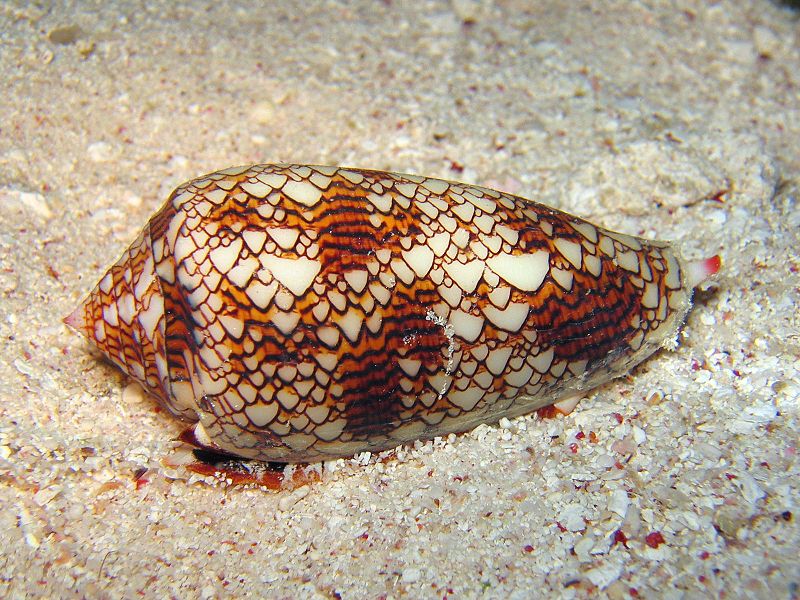
Also this shell apparently looks like a representation of chaos called rule 30, which was developed by the guy behind Wolfram Alpha. If you're looking for a fin Wikipedia hole to fall down, chaos theory is a good place to start.
It's pretty cool and illustrates lag pretty well. The top rod goes back and forth (duh) but the bottom rod lags behind and over compensates for the changes, leading to the cool pattern. According to wikipedia this is "one of the simplest dynamical systems that has chaotic solutions." The article has lots of math, but some other very cool visuals, some of which I do not understand.
Also this shell apparently looks like a representation of chaos called rule 30, which was developed by the guy behind Wolfram Alpha. If you're looking for a fin Wikipedia hole to fall down, chaos theory is a good place to start.
Thursday, April 20, 2017
A BUNCH OF PALEONTOLOGISTS ARGUE OVER WHETHER OR NOT PROTOTAXITES WAS A GIANT FUNGUS OR A ROLL OF MOSS!!!!
Remember when we learned about that enigma fossil prototaxites? The one that maybe looked like a giant... well... it looked vaguely phallic. Some say it was actually a roll of liverwort moss. I'm skeptical of this, but the way I found these articles on the Web of Science is hilarious.
At the bottom of the page was this article:
http://apps.webofknowledge.com/full_record.do?product=WOS&search_mode=OneClickSearch&qid=29&SID=1F9ceq7GOkeWkpBd6Et&page=1&doc=10
with the title: STRUCTURAL, PHYSIOLOGICAL, AND STABLE CARBON ISOTOPIC EVIDENCE THAT THE ENIGMATIC PALEOZOIC FOSSIL PROTOTAXITES FORMED FROM ROLLED LIVERWORT MATS
Above that, was an article by the same people from later that year:
http://apps.webofknowledge.com/full_record.do?product=WOS&search_mode=OneClickSearch&qid=32&SID=1F9ceq7GOkeWkpBd6Et&page=1&doc=9
with the title:
ROLLED LIVERWORT MATS EXPLAIN MAJOR PROTOTAXITES FEATURES: RESPONSE TO COMMENTARIES
Directly above was an article from the SAME ISSUE AS THE LAST:
entitled: THE ENIGMATIC DEVONIAN FOSSIL PROTOTAXITES IS NOT A ROLLED-UP LIVERWORT MAT: COMMENT ON THE PAPER BY GRAHAM ET AL. (AJB 97: 268-275)
Wow. So much salt.
Wednesday, April 19, 2017
CRISPR and Human Gene Therapy
Hey guys!
So this doesn't have as much to do with our current topics in the class, but I think it is a pretty important area of modern Biology (it was first discovered only in 2005) so I thought I would post about it (and it's kind of about biodiversity in bacteria and archaea).
I recently started working at the Arias lab that works in virology primarily with CRISPR-Cas9.
Many bacteria and archaea have a section of DNA known as CRISPR (Clustered regularly interspaced short palindromic repeats) that will produce RNA that will create a complex with a protein called Cas9. This complex is designed to find and cut apart foreign DNA from phages or plasmids and is a powerful form of defense for these organisms. Scientists have managed to develop our own versions of this complex; one of the most exciting parts of the CRISPR-Cas9 complex is that it can actually be engineered to cut out specific parts of a genome and then that area can be potentially replaced with whatever the scientist chooses. Our usage of this complex is not too advanced yet, but the potential for gene therapy and the ability to literally design a complex that can entirely cut out a genetic disorder in a developing baby is pretty huge. This is currently one of the primary contenders for gene therapy and it will be exciting to see how the technology develops in the future.
Cool video explaining how it works
Tuesday, April 18, 2017
Endosymbiosis of the Powerhouse of the Cell
Does anyone else find it entertaining when you mention the mitochondrion during a discussion entirely in context and someone instinctively blurts out "mitochondria are the powerhouses of the cell"? Well, as we discussed just last week, they weren't always the powerhouses of eukaryotic cells. It turns out that the scientific community currently has more questions than answers about when, why, and how endosymbiosis most likely occurred.
Summary of this review paper, entitled "The origin and early evolution of mitochondria"
Summary of this review paper, entitled "The origin and early evolution of mitochondria"
- Organism with genetically "richest" mitochondrial genome (most likely resembles ancestral protist that underwent symbiosis) is called Reclinomonas americana
- Like viruses, mitochondrial genomes underwent "reductive evolution," in which their genomes decreased in size by throwing out genetic information that was redundant within the host cell's genome
- Genome sequencing alludes to the possibility that ALL mitochondria are derived from a single mitochondrion, meaning that this relationship arose only once in evolution
- While it is not clear when exactly the mitochondrion entered the eukaryotic cell, the evidence is clear that they primarily evolved together to create the Eukarya domain
- Mitchondria likely arose from a parasitic intracellular alpha-proteobacteria
While all of this is exciting, the evidence needs to be considered with a skeptical frame of mind. Much of the data to support the claims above came from genome sequencing, and the parts determined to be ancestral to the original mitochondrion may well just be ancestral to the universal common ancestor (for argument can be made that some of the genetic material in the mitochondrion that was considered in these studies have very far relatives in bacteria, archea, and eukarya).
So while it was an interesting read, and I think a lot was learned, not a lot was definitively claimed. But so is science.
Subscribe to:
Posts (Atom)