Showing posts with label Animal behavior. Show all posts

Monday, May 20, 2019

Courtship & Parenting Tips from the Male Superb Fairy-Wren (Malurus cyaneus)


Native to the scrubland fringes of Australia’s eucalypt woodlands, superb fairy-wrens spend most of their days hunting grasshoppers or snuggling on low-hanging branches in bundles of 2… 3… sometimes 5. Lavishly-feathered, “rampantly promiscuous,” and a common visitor of children’s parks, they’ve been ballyhooed by The Guardian as Australia’s favorite bird. Despite their cotton-ball size, these flamboyant daredevil passerines pack a suit of evolutionary aces up their tail feathers, especially when it comes to courtship!


1. Keep in mind that your vibrant plumage attracts predators


3 seasons of the year, fairy-wrens don the drab, downy coloration of a miniature koala, but come the next molt, all bets and feathers are off. With dazzling sapphire cheek plumes and a midnight-blue jabbot, the breeding plumage of the male superb fairy-wren is a spectacle of sexual selection. But while gleaming like a crown jewel captivates females, it’s also a flashy candy wrapper to predators. Being sexy is dangerous.

Male fairy-wrens are cognizant and even cautious of this (McQueen, Naimo, Teunissen et. al. 2017). In their 2017 paper, “Bright Birds are Cautious: Seasonally Conspicuous Plumage Prompts Risk Avoidance By Male Superb Fairy-Wrens,” an Australian research team details differences in antipredator responses between superb fairy-wrens of different plumage types. Broadcasting the species’s alarm calls to a population in Lysterfield Park, Australia, they found that blue males were 50% less likely to forage on open ground, took over twice as long to reemerge from cover, and showed a stronger immediate response to predator alarm calls (2017). They propose that breeding fairy-wren males are well aware of their conspicuous plumage and make behavioral adjustments accordingly to avoid predation, and that flock members can benefit from the heightened vigilance of these blue males, either as an early warning system or as a bright decoy (2017).


2. When in doubt, bring her flowers


Because being fabulous ain’t enough to turn up the charm, the superb fairy-wren suitor will bequeath females with a single yellow flower petal, perhaps to accentuate his scintillating blue-black plumage. However, despite the temptingly-anthropomorphic similarities, petal-bearing is no diamond-ring proposal – more like a booty call!

Superb fairy-wrens have the highest rate of “extra-pair fertilization” (AKA cheating) out of any bird species (Double, Cockburn 2000). Though superb fairy-wren flocks are headed by an older, territorial “primary” male that is socially bonded to a single female, cheating is rampant, and a whopping 95% of their broods contain offspring sired by a different father (Mulder, 1997; Mulder, Dunn, Cockburn et. al.  1994). An observation-based study by Raoul A. Mulder, “Extra-group Courtship Displays and Other Reproductive Tactics of Superb Fairy-wrens,” determined that in its 375 observations of fairy-wren courtship displays, petal bearing was performed “exclusively (97%) for extra-group females during excursions into neighbouring territories by lone males, and appears to have evolved specifically for the purpose of soliciting future extra-pair fertilizations” (1997).


3. Evolve Extra-Fancy Sperm


Polygamy’s rough – to maximize reproductive success, individuals of promiscuous species not only have to tirelessly woo as many partners as possible, but also have to deal with sexual selection post-copulation – rife with chemical manipulation, copulatory inhibitors, competitive sperm morphology, hostile pH fluctuations, and intersexual conflict, fertilization is a gametic war zone. Mating multiple times is great, but how does an organism ensure that each of its efforts successfully produced offspring?

Sometimes, it’s a numbers game. Fairy-wrens are known for their copious sperm loads – Malurus splendens, a close cousin to the superb fairy-wren, produces over 8.3 billion sperm per ejaculate (In comparison, a dose of human ejaculate only contains around 280 million) (Tuttle, Pruett-Jones, Webster 1996)!

Alongside gamete quantity, sperm variation and competition becomes especially intense amongst superb fairy-wrens, where the reproductive success of different paternal strategies vary with sperm morphology (Calhim, Double, Margraf et. al. 2011).
In quantifying the relationship between head : flagellum ratio and reproductive success in this species, Calhim, Double, Margraf et. al. mist-netted, banded, and non-invasively sampled sperm from M. cyaneus males from different reproductive stages in their life history. After observing and determining parentage of the offspring, the team calculated intrapair success, measured as the number of offspring the male sired for his social mate, as well as extrapair or “cuckolding” success, “measured as the lifetime number of illegitimate offspring that survived to four weeks after fledgling” (2011). Their study, “Maintenance of Sperm Variation in a Highly Promiscuous Wild Bird,” details that intrapair success was strongly associated with a longer flagellum and relatively shorter head, while a short flagellum and a relatively large head was associated with better extrapair success (2011).


4. Help your mate teach your chicks a song to distinguish them from brood parasites.


Even after their eggs are laid and their brilliant feathers dust over, fairy-wren parents must still be on high alert: both for predators, and for the insidious Horsfield’s bronze cuckoo, who lurks around poorly-guarded nests. Given the opportunity, the female cuckoo will descend, roll one of the wrens’ eggs out of the nest, and replace it with one that looks deceptively similar – pink, with a ring of dark speckles at its base. Securely tucked within the lofty grass walls of the nest, superb fairy-wren parents would hardly be able to tell the difference, so what they do instead is sing a secret passcode to their eggs (Colombelli-Ne´grel, Hauber, Robertson et. al. 2012).

9-10 days before the brood hatches, superb fairy-wren mothers titter a fast, high-frequency trill ranging from 5782.8-11,011,2 ± 250.0 Hz, which her chicks embryonically learn as they develop within their eggs (2012). Within every incubation call is a signature sequence that is unique to each female – the hatchlings who can sing their mother’s fingerprint best are the ones who get fed, and the hatchlings that can’t imitate her calls are abandoned or discarded (2012). The females communicate this to their mates, too, so that they could aid in distinguishing their chicks (2012). The eggs hatch after 15 days, and as the cuckoos start laying 13 days into the fairy-wrens’ incubation period, their foreign chicks get less time to memorize their foster mother’s calls, and thus are most likely to be pushed or starved out of the nest (2012). The joint team of psychology and zoology researchers who reported these findings in their paper, “Embryonic Learning of Vocal Passwords in Superb Fairy-Wrens Reveals Intruder Cuckoo Nestlings,” speculate that this co-evolutionary arms race between superb fairy-wrens and their brood parasites could intensify selective pressures for finer-tuned acoustic learning in both species’s offspring (2012).


All in all, superb fairy-wrens are frickin’ awesome! Ever flitting, singing, and glittering in the Aussie sun, these avian divas are a star 3.4 billion years in the making. Their richly-textured social lives have established new extremes in our study of coevolution, intersexual conflict, postcopulatory selection, and avian social psychology, and that’s barely the beginning of the profound body of research that needs to be done on this species. It just goes to show that even the tiniest species have eons to reveal about the diversity of life on Earth, and our study of evolution will never be complete without them!

SOURCES:

Colombelli-Ne´grel, D. Hauber, M. E. Robertson, J. et. al. (2012).
Embryonic Learning of Vocal Passwords in Superb Fairy-Wrens Reveals Intruder Cuckoo Nestlings. Current Biology, 22: 2155–2160.

Mulder, R. A. Dunn, P. O. Cockburn, A. et. al. (1994). Helpers liberate female fairy-wrens from constraints on extra-pair mate choice. Proceedings of The Royal Society B, 255(1344): 223-229.

Tuttle, E. M. Pruett-Jones, S. Webster, M. S. (1996). Cloacal protuberances and extreme sperm production in Australian fairy-wrens. Proceedings of The Royal Society B, 263(1375): 1359-1364.

Calhim S, Double MC, Margraf N, Birkhead TR, Cockburn A (2011) Maintenance of Sperm Variation in a Highly Promiscuous Wild Bird. PLoS ONE 6(12): e28809. https://doi.org/10.1371/journal.pone.0028809

Mulder, R. A. (1997). Extra-group Courtship Displays and Other Reproductive Tactics of Superb Fairy-wrens. Australian Journal of Zoology, 45(2) 131 - 143.

McQueen, A. Naimo, A. C. Teunissen, N. et. al. (2017). Bright Birds are Cautious: Seasonally Conspicuous Plumage Prompts Risk Avoidance By Male Superb Fairy-Wrens. Proceedings of The Royal Society B, 284(1857).

Double, M. Cockburn, A. (2000). Pre–Dawn Infidelity: Females Control Extra-Pair Mating in Superb Fairy–Wrens. Proceedings of The Royal Society B, 267(1442): 465-470.

Wednesday, March 6, 2019

Bird Journal - Brown Pelicans


A flock dozing off at Elkhorn Slough – July 23, 2017. Monterey Bay, CA


Brown pelicans are the lumbering Paul Bunyans of the seabird world. The snaking arcs of their necks look almost prehistoric, and indeed, the earliest known pelican, dating back to over 30 million years ago, exhibits little to no change in fundamental morphology (Louchart, Tourment, Carrier 2011)! 

As exclusively-oceanic predators, they have a bunch of cool sea-faring adaptations: specialized glands that allow them to drink salt water (Schmidt-Nielsen, Fange 1958), air sacs under their skin for added buoyancy (US Fish and Wildlife Service 2009), as well as a hunting technique that is novel amongst other Pelecaniids. 

The brown pelican is unique in that it’s the only plunge-diving pelican species in existence (2009). While most others of its clade will scoop at fish while sitting at the water’s surface, brown pelicans dive-bomb the sea like war jets, tucking their wings behind them in one deadly thrust. The timing of this part is crucial. If they don’t corkscrew to the right by just the right amount, they could fatally injure their trachea and esophagus. 

Assuming all goes well underwater, they flap their gums open. Their gular pouch balloons out like a 3-gallon net, ensnaring the hapless fish between their jaws: anchovies, sardines, herring, sheepshead, mullet, pigfish… Occasionally, they’ve even been seen gulping down crustaceans (2009). 

These ambush strategies have proven fruitful in chasing the ever-fast and finicky epipelagic fish, but plummeting from heights of 60 ~ 70 feet is not a skill they are born with (2009). Before maturing into sleek, bow-winged adults, pelican youngsters look something like this: 

It’s like an overcooked marshmallow tried to grow feathers (a 3-5 month old juvenile) – July 3, 2017. San Francisco, CA.

These little ones, while cute, are honestly terrible at fishing. I got the chance to see this particular one attempt a dive, during which it lost balance and smacked against the water in an explosive belly-flop! A 1969 paper, “Age and Hunting Success in the Brown Pelican (Pelicanus occidentalis)” by Gordon H. Orians, attests that plunge-diving is a technique that takes years to develop. Using a paired t-test of nearly 2000 observations off the coast of Playas del Coco, Costa Rica, Orians compared the catch rates amongst different life stages of brown pelicans, and found significant evidence that the learning period for the juvenile birds takes at least 18 months to 2 years (1969). Orians remarks that this phenomenon, if widespread, could in part explain why brown pelicans, as do many sea-faring bird species, exhibit an unusually delayed maturation (1969) – while juvenile brown pelicans fully fledge at about 3-5 months of age, they don’t reach sexual maturity until they’re about 3 years old (US Fish and Wildlife Service 2009). 

Once they hit breeding age, their chocolatey manes melt away. Their lores and bill area flush with color, and their eyes metamorphose from deep brown to salty-pale. 

As social birds, adult pelicans can often be seen soaring together in V-formation over the beaches of North and South America. There are lots of them diving off Santa Barbara and especially IV, so next time you see one of these bombardiering specialists, try and see if you could pick out the steps in its technique! 


SOURCES:

Department of the Interior, U.S. Fish and Wildlife Service (2009). Brown Pelican [Fact sheet]
Retrieved from
https://www.fws.gov/home/feature/2009/pdf/brown_pelicanfactsheet09.pdf

Louchart, A. Tourment, N. Carrier, J. 2011. The earliest known pelican reveals 30 million years of evolutionary stasis in beak morphology. Journal of Ornithology, 152(1): 15-20. 

Orians, G. H. 1969. Age and Hunting Success in the Brown Pelican (Pelecanus occidentalis). Animal Behavior, 17: 316-219. 

Schmidt-Nielsen, K. Fange, R. 1958. The Function of the Salt Gland in the Brown Pelican. The Auk, 75(3): 282-289. 

Sunday, March 4, 2018

Divorce of a Lizard

The phrase "in sickness and in health" is commonly included in many marriage vows, but may not be the finest evolutionary strategy for many monogamous species. Shingleback skinks (Tiliqua rugosa) are usually quite the adorable monogamous lizard; some pairs have been found to reunite to mate for over 20 years in a row. This puzzled behavioral ecologists, because unlike other monogamous species (like migrating birds and humans), monogamous reptilians don't partake in childrearing. They questioned what the fitness advantage of monogamy could be. A long term study on parasites of the shingleback could be their answer! It found that males were less likely to retain their previous monogamous partner if their tick load was higher.  From a parasitic perspective, having a monogamous pair makes a lot of sense, because pairs with low infection levels are less likely to become infected if they remain with the same partner. Alas, this lizard "marriage" only remains "in health"; when the male gets too many ticks, the fitness advantage is lost, and so his partner!
If you wanna learn more about this study and rad shingleback skinks:   https://link.springer.com/content/pdf/10.1007%2Fs00442-005-0224-z.pdf

Thursday, May 8, 2014

Defying Trophic Levels


Urchin eating baby cormorant bird.
You might have gotten this email too, but just in case I wanted to share this strange phenomenon.  In ecology we often look at a fixed trophic structure or even a complicated food web.  I think this proves that the food web is more dynamic than we realize.  Urchins have a pretty adaptable diet. Maybe birds are not a preference, but I'm sure this meal was nutritious!  (It still gives me the creeps though.)

 Check out the article for video proof:
http://deepseanews.com/2014/05/anemone-consumes-a-baby-seabird/

This is a link to the paper recently published from a study in oregon:  http://www.marineornithology.org/PDF/42_1/42_1_1-2.pdf

Wednesday, May 23, 2012

Swim bladders and the "Barry White of the Sea"

Here is the link to the NY Times story I mentioned in class a few lectures ago on vocalizations made by fish using their swim bladders.  The article highlights several cases in which obnoxious noises were assumed to be anything BUT made by fish and those who suggested fish as the culprits were called crazy!  As I mentioned the swim bladder is thought to be evolutionarily homologous to the early lung and both develop as outpockets of the gut (in the early stages of development). A paper by Zheng et al., published in 2011 in PLoSONE looks at some of the evidence for the "homolog" idea, and their results "provide molecular evidence of the relatedness of the fish swimbladder and mammalian lung."

Black drum

Here also is the link to some of the cool sounds fish make, including the "Barry White of the sea", the black drum.

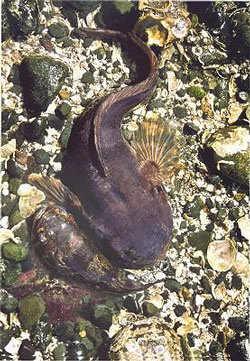
And one more link: this one describing research by SFSU professor Roger Bland on the vocalizations of the toadfish in SF Bay.

Toadfish

Tuesday, April 10, 2012

Smart octopus tricks

I'm back. Did you miss me? I'm reluctant to start with repeat but here's a most spectacular octopus camouflage video. I like the way the octopus gets a round of applause.
Of course as biologists we want to look a little deeper. The cool bit is that it gets even more amazing as you think about it more closely. As PZ Myers pointed out on his blog, the octopus needs to do four things to achieve this trick:
  1. It needs good visual system. In order to match the background you need to be able to see it. To match it well, you need to see it well.
  2. To pull off the fast change you need a fast connection from the brain to the color changing organ.
  3. Speaking of which, yes, the octopus needs organs that can change color. Cephalopods have tiny, discrete sacs of pigment scattered all over their body, each one ringed with muscles that can close the sac to conceal the pigment, or expand the sac to expose the pigment.
  4. Finally, the octopus needs a set of rules, an algorithm, so it can translate what is sees with its eyes into a visual pattern that hides the animal.
For more information check out the website of Roger Hanlon at Woods Hole Marine Biological Laboratory. The New York Times had a nice article on his lab recently, Revealed: Secrets of the Camouflage Masters. For a more scientific, but still very accessible treatment, see Cephalopod dynamic camouflage, in Current Biology.

Thursday, March 15, 2012

Wrap up

Thank you one and all for your presentations today. Excellent timekeeping by everyone and  such a diverse range of topics.

If you did not receive your Multiple Choice Quiz back that means that it was all present and correct - good work.

After ten weeks of daily posts (a habit is a powerful thing) I'm going to take a break from posting here every day but will return next quarter.

Good luck with your finals and have a fun Spring Break. Here's a final Spring Break related topic from a paper in Science this week that the media are naturally picking up on: 
eg in the Washington Post - Real barflies: Study explains why male fruit flies turn to alcohol when they can’t have sex
 The actual paper in Science is here: Sexual Deprivation Increases Ethanol Intake in Drosophila
(my new favorite paper title)
and there's a commentary on the paper here: Sexually Rejected Flies Turn to Booze

Offer a male fruit fly a choice between food soaked in alcohol and its nonalcoholic equivalent, and his decision will depend on whether he's mated recently or been rejected by a female. Flies that have been given the cold shoulder are more likely to go for the booze, researchers have found. It's the first discovery, in fruit flies, of a social interaction that influences future behavior. 

Thursday, February 2, 2012

Evolution's Rainbow

There was some discussion of the evolution and maintenance of homosexuality under Darwinian selection today. One of the most interesting thinkers in this area is Joan Roughgarden at Stanford. Her book, Evolution's Rainbow: Diversity, Gender, and Sexuality in Nature and People is a must read for anyone remotely interested in this topic. 


One of the reasons I say 'must read' though is that Roughgarden's idea have been quite controversial.

If you don't have the time to read a whole book then there are numerous essays and magazine articles that summarize the book and its arguments eg. The effeminate sheep and other problems with Darwinian sexual selection.
or
Rethinking sex
Take a look, it might inspire you to read the book.

Monday, May 9, 2011

Ant rafts

Okay, I'm feeling a little woozy because I just had root canal surgery (which is not as bad as its reputation but I still feel like I got punched in the face), but even so, how can you NOT be a biologist when there are papers like this:
Fire ants self-assemble into waterproof rafts to survive floods

 Why does a single fire ant Solenopsis invicta struggle in water, whereas a group can float effortlessly for days? We use time-lapse photography to investigate how fire ants S. invicta link their bodies together to build waterproof rafts. Although water repellency in nature has been previously viewed as a static material property of plant leaves and insect cuticles, we here demonstrate a self-assembled hydrophobic surface. We find that ants can considerably enhance their water repellency by linking their bodies together, a process analogous to the weaving of a waterproof fabric. We present a model for the rate of raft construction based on observations of ant trajectories atop the raft. Central to the construction process is the trapping of ants at the raft edge by their neighbors, suggesting that some “cooperative” behaviors may rely upon coercion. 

Sunday, March 6, 2011

Career opportunities

Who knew that panda impersonator was even a valid career option?

From a Time Photo-story: Giant Panda People - scientists don costumes for good cause.

In 1980, the Chinese government teamed up with the World Wildlife Fund to establish the China Conservation and Research Center for giant pandas. Since then, with 100,000 visitors a year, it has become the most popular place on the planet to see giant pandas in their habitat. The reserve's mission is to observe, study and breed the endangered species to increase their chances of survival. So far the reservation has successfully bred 66 panda cubs.

Part of the reserve's mission includes placing the pandas it has bred back into the wild. Because previous attempts to reintroduce captive pandas into the wild have been largely unsuccessful, the researchers have developed the novel technique of dressing as the animals to acclimate them to the wild.


I think we need one more picture but you should check them all out at the Time website.

Is the 'panda' on the left eating bamboo? That seems to be taking method acting a bit too far...

Tuesday, February 22, 2011

Haplodiploidy

Haplodiploidy is a  mechanism of sex determination that is common in the hymenoptera but also found in some other groups. In this system sex is determined by the number of sets of chromosomes an offspring receives. Fertlized eggs develop as females, and unfertilized eggs develop as males. This means that the males have half the number of chromosomes that a female have - hence the name haplodiploidy for this system. In this system males have no father and cannot have sons, but have grandfathers and can have grandsons (think about it). Also because males are already haploid all the sperm they produce is identical.

Haplodiploidy has important consequences that seem to affect social behavior. Here's a nice description form an online Animal Behavior textbook:
  1. If a queen mates only once, her daughters are highly related to each other (called supersisters), because the father's sperm are all identical.
  2. A female is more related to her sisters (on average, 75% similar) than she is to her own daughters (on average 50% similar).
  3. A female is more related to her son (50 % similar) than she is to a brother (on average, 25% similar).
These three factors combine to create a condition in which it may be more advantageous, evolutionarily speaking, for a female to help her mother produce sisters (to the female in question) than to produce her own daughters. Thus haplodiploidy opens the way for the evolution of a worker caste, devoted to helping their mother. If workers evolve under these conditions, then we would expect:
  • That all workers will be female (males have no special pattern of relatedness in a haplodiploid system that would make working advantageous to them
  • That workers will help their mother to lay and rear females, but
  • That workers would prefer to lay their own male offspring, rather than rear brothers
In fact, Hymenoptera workers are uniformly female and conflict between the queen and the workers over who lays the males eggs in a nest is common. The role of haplodiploidy in the evolution of worker Hymenoptera fits into an overall theory of how genetic similarity affects social behavior called kin selection which was developed by Bill Hamilton.

Sunday, January 23, 2011

Fascinating Amoeba Farm Bacteria


Farming is often thought of as a completely human idea, though many animals actually engage in "farming behavior", however none of these species has been as tiny as the Dictyostelium discoideum slime mold.
As an example of animal farming behavior: some Damselfish actually farm their own algae and are surprisingly protective of it. They will often attempt to attack humans that disrupt their algae farms!
D. discoideum farms bacteria is a very interesting little oragnism according to BBC News:
"More than just a snack for the journey of dispersal, the idea is that the bacteria that travel with the spores can 'seed' a new bacterial colony, and thus a food source in case the new locale should be lacking in bacteria.
D. discoideum is already something of a famous creature, having proven its 'social' nature as it gathers together into a mobile, multicellular structure in which a fifth of the individuals die, to the benefit of the ones that make it into the fruiting body.
'Bacteria generally provide huge resources that are really untapped,' Ms Brock said.
'These amoebas carry bacteria that aren't just used for food, so that's what I'm looking into now.'"


The untapped power of bacteria is certainly an interesting topic, as is the unique symbiosis and initial possible evolutionary cost of farming behavior.

Read the article here: BBC New- Amoebas show primitive farming behaviour as they travel

-Deirdre

Tuesday, May 25, 2010

Male antelope scares female into staying for sex

During mating season, male topi antelope trick females with false alarms of nearby danger to boost chances for sex, a new study says. If a female starts wandering out of a male's territory, the male will begin snorting and staring, ears pricked, at nonexistent predators."The female will be walking away, and the male runs in front, looks not at the female but where she's going, makes this snort, and she typically stops," said lead researcher Jakob Bro-Jørgensen of the University of Liverpool.

The paper is in The American Naturalist (Male Topi Antelopes Alarm Snort Deceptively to Retain Females for Mating) and there's a news report at the National Geographic site.

Sunday, May 9, 2010

Octopusnuff

Huh? It's hard to make up a word that nobody has used on a webpage, ever. But apparently I did. I assume if you try that link in a few days/weeks/months? this page will then show up. [I checked a little over an hour later and this page was already there! I didn't realize google searched the web so continuously]. Anywho. I apologize to all cephalopod lovers for putting up the first video. But I believe it helps make three points:
1) You'll appreciate the selection pressure that led to video 2.
2) The evolution of shells and external skeletons led to so called 'adaptive radiations' in certain groups as they, temporarily, escaped their predators. This video shows the problems of the unarmored.
3) Remember one of the advantages of group living was being able to prey on larger or more difficult prey? I rest my case.


This next one is for the cephalopod lovers. You may have seen it before but it amazes me how the octopus mimics not just the colors but also the texture of the algae.

Tuesday, April 13, 2010

Sea Otters: Cute lil critters or sex crazed maniacs?

Claudia showed some cute sea otter pictures but sea otters always look cute - they probably look cute even when they are practicing necrophilia or trying to rape baby harbor seals.

Without even trying too hard sea otters can reach almost lethal levels of cuteness. Anyone remember this viral video from a few years back (check out the number of hits - almost 14 million!). At about 1:20 into this video the cuteness level gets dangerously high.

Thursday, April 1, 2010

I googled dragonfly penis so you don't have to....

There are numerous articles on this topic (people love to read about freaky animal sex). National Geographic's is pretty good but, sadly, does not include any pictures of the 'rigid, spoonlike, and sometimes spiky' penis. The picture to the left is from Jonathan Waage's seminal (pun intended) paper Dual Function of the Damselfly Penis: Sperm Removal and Transfer

Grab, shake, bite, gouge, puncture, split, punch: It's enough to put anyone off sex.

In a brilliant experiment some years ago, Jonathan Waage of Brown University discovered the Rosetta stone to this strange mating behavior. Waage studied the jewelwing damselfly Calopteryx maculata. First he examined the sperm-storage organ of females after a couple of matings to determine whether sperm from a second mating was added to sperm from the first. He was surprised to find that the amount of sperm hadn't changed. Then he dissected pairs in the midst of copulation and studied their sex organs under an electron microscope. The experiment revealed that a male dragonfly uses his penis not just to transfer sperm to the female, but also to remove sperm left in her storage organ from previous matings. When he curls into that wheel position and begins his energetic genital thrusting, he's actually using his rigid, spoonlike, and sometimes spiky, penis to scrape out rival sperm before he deposits his own.

Such a ploy is necessary, Corbet says, because of female choice and sperm competition. A female nearly always mates with more than one male; it's in her interest to "upgrade" her fertilizations if she can, thereby exercising choice over the paternity of her offspring. Males want their sperm alone to prevail, so they have evolved strategies for purging other sperm and for discouraging mates from copulating with rivals. In this game of sexual chess, the last sperm into the female's storage organ wins by fertilizing her eggs.

Thursday, March 11, 2010

The Crow Paradox

Congratulations to Garrett for the 500th posting to the CCSBio blog. Sadly there is no prize. (no, not even a 'no-prize').

I'm now set up for the rest of the quarter (or what remains) because your presentations have reminded me of a number of items.

Thanks again for presenting. I thought everybody did a great job and almost all of you kept to time well. Sorry for being so strict on time, it would have been great to follow each person with a few questions or discussion, but you have to be tough when you are trying to fit in a lot of presentations.

Inspired by Whitney's talk about facial recognition I thought some of you might enjoy this little NPR animation. I don't think I can embed it but if you click the image it will take you to the NPR page with the video. Yes, that is Dick Cheney.

Here's a surprise: Wild crows can recognize individual people. They can pick a person out of a crowd, follow them, and remember them — apparently for years. But people — even people who love crows — usually can't tell them apart.

Can YOU recognize different crows?

Thursday, May 14, 2009

Talking Prairie Dogs

In this week's New Scientist magazine is a report of a paper just out in the journal 'Animal Cognition': Prairie dog alarm calls encode labels about predator colors.

Prairie dogs talk some pretty colourful talk. Not only do their alarm calls tell others about the type and size of approaching predators, but it seems they can also warn of the hue of an imminent threat.

Gunnison's prairie dogs are burrowing rodents that live in the grasslands of North America. Con Slobodchikoff of Northern Arizona University in Flagstaff and his colleagues had previously shown that they produce different alarm calls in response to humans, coyotes, domestic dogs and red-tailed hawks. For humans, the calls even vary according to the person's size. They react differently towards each call, all hiding if approached by humans, whereas only nearby animals hide if it is a hawk.

In the latest study, the team recorded the alarm calls as three similar-sized women wearing blue, yellow or green T-shirts walked past the prairie dogs 99 times. They found that the calls were similar for green and yellow T-shirts, but significantly different for blue.

Prairie dogs have dichromatic vision, a form of colour blindness where only two of the three primary colours can be discerned. As they are sensitive to blue and yellow, this explains why they cannot distinguish green. Still, the fact that they can "talk" colour "probably makes this the most sophisticated animal communication system that has been decoded so far," says Slobodchikoff.

Friday, April 10, 2009

Grunion Run


Not an athletic event, the Grunion Run is a remarkable annual occurrence where the little grunion fish comes ashore to spawn. Peak spawning season typically occurs from April through early June and the grunion runs occur late at night, twice a month, after the highest tides associated with a full or new moon.

Now you too can be a part of this:

A professor at Pepperdine collects data on grunion runs on California beaches and organizes "grunion greeters" to help collect the data. Members of our Bio departments have been involved every year thus far and will be involved this year as well. If you're interested in watching grunion runs and reporting what you see, Dr. Karen Martin will be coming to campus next Wednesday evening (April 15) to conduct a volunteer workshop in MSRB. Check out the flyer for more information.

Tuesday, March 10, 2009

Cephalopod star

There are a lot of amazing octopus videos around. Here's the most famous camouflage one:


Of course as biologists we want to look a little deeper. The cool bit is that it gets even more amazing as you think about it more closely. As PZ Myers pointed out on his blog, the octopus needs to do four things to achieve this trick:
  1. It needs good visual system. In order to match the background you need to be able to see it. To match it well, you need to see it well.
  2. To pull off the fast change you need a fast connection from the brain to the color changing organ.
  3. Speaking of which, yes, the octopus needs organs that can change color. Cephalopods have tiny, discrete sacs of pigment scattered all over their body, each one ringed with muscles that can close the sac to conceal the pigment, or expand the sac to expose the pigment.
  4. Finally, the octopus needs a set of rules, an algorithm, so it can translate what is sees with its eyes into a visual pattern that hides the animal.
For more information check out the website of Roger Hanlon at Woods Hole Marine Biological Laboratory. The New York Times had a nice article on his lab recently, Revealed: Secrets of the Camouflage Masters. For a more scientific, but still very accessible treatment, see Cephalopod dynamic camouflage, in Current Biology.