The argument over whether an outcrop of rock in South West Greenland contains the earliest known traces of life on Earth has been reignited, in a study published in the Journal of the Geological Society. The research, led by Martin J. Whitehouse at the Swedish Museum of Natural History, argues that the controversial rocks "cannot host evidence of Earth’s oldest life," reopening the debate over where the oldest traces of life are located.
For Biology students in the College of Creative Studies at the University of California Santa Barbara.
Saturday, February 28, 2009
Controversy Over World’s Oldest Traces Of Life
The argument over whether an outcrop of rock in South West Greenland contains the earliest known traces of life on Earth has been reignited, in a study published in the Journal of the Geological Society. The research, led by Martin J. Whitehouse at the Swedish Museum of Natural History, argues that the controversial rocks "cannot host evidence of Earth’s oldest life," reopening the debate over where the oldest traces of life are located.
Friday, February 27, 2009
Bird identification
But today the Smithsonian houses the 'Feather Identification Lab' where a staff of four analyze the remains of over 4,000 bird-plane collisions a year. The New York Times had a nice article on the lab: Identifying the Bird, When Not Much Bird Is Left.
Although you might think that these days it could all be done by DNA analysis instead of experts looking at feathers the article illustrates that DNA analysis will only take you so far. In one recent case the DNA from a bird strike at 1,500 feet came back as a deer. It required a human expert to identify the feather as coming from a black vulture - explaining the presence of deer DNA in the engine.
Thursday, February 26, 2009
Toucan time
There are numerous programs that can do this. The problem is that many of them do a great many things so can be difficult to get started with. I tried to find one that can do what we require here and SimpleClade looks like it will be up to the task.
Wednesday, February 25, 2009
Freaky frogfish
It's been a while since we had a crazy critter here - although we did see some bizarre plants on Saturday.This new species of frogfish uses its leg like pectoral fins to crawl - that is when it isn't bouncing around like a rubber ball. See yesterdays University of Washington press release for information and some great photos and video.
Members of Histiophryne psychedelica, or H. psychedelica, don't so much swim as hop. Each time they strike the seafloor they use their fins to push off and they expel water from tiny gill openings on their sides to jet themselves forward. With tails curled tightly to one side --which surely limits their ability to steer -- they look like inflated rubber balls bouncing hither and thither.
Tuesday, February 24, 2009
For Thursday
This link will serve as a refresher to the ideas behind cladistic analysis that we discussed earlier in the quarter and illustrates a simple mechanism for constructing a cladogram for taxon provided it doesn't have too many species. Please read this before Thursday.
Once the number of species becomes large the task of calculating the most parsiomonious tree rapidly becomes unmanageable. Fortunately computers are very good at this and there are numerous programs available which can be used, this site lists 386 phylogeny packages!
Monday, February 23, 2009
Three seminars and an opportunity
Vertebrate and Wetland Resources of the Goleta Slough
Monday February 23 6-7pm, Rm 1013, Harder South.
Susan Foster, Department of Biology, Clark University
Ancestral Plasticity and Evolutionary Diversification: The Stickleback Adaptive Radiation
Date: Monday, February 23, 2009
Time: 4 p.m. - 5 p.m.
Helen Poynton, Postdoctoral Fellow,U.S. Environmental Protection Agency
Wednesday, Feb. 25, 12:30 - 1:30 p.m. Bren Hall 1414
Small, Smaller, Nano! A Daphnia Magna DNA Microarray for Biomarker Discovery and Environmental Monitoring of Metal-based Nanomaterials.
Snowy Plovers Docent Volunteers Needed at Coal Oil Point Reserve!
The next training is at the Reserve Office at Coal Oil Point Reserve,
Saturday, March 7th, 9AM-1:30PM
To register, please contact the Program Coordinator, Jennifer Stroh:
office: 805-893-3703
stroh@lifesci.ucsb.edu
Sunday, February 22, 2009
Magic pill
In a way this is surprising because the study was so large and looked at so many aspects of health that it had a lot of statistical power to detect even a small effect. The study involved more than 160,000 women roughly split between those that took regular multivitamins and those that didn't. Eight years later they looked at a variety of disease incidences, including cancer (almost 10,000 cases) and cruder measures such as total mortality (again almost 10,000 deaths). Not even a hint of a difference.
Combined with other recent studies showing no effect of multivitamins in men and in children the evidence is pretty clear that the twenty BILLION dollars Americans spend each year on multivitamins is a waste of money.
Eat healthy. Exercise. Don't smoke. Wear a seat belt. Statistically these things are proven to be likely to add years to your life (individual results may vary of course). It's pretty simple but the allure of a magic pill continues to sucker people in.
Saturday, February 21, 2009
Lotusland
Here are two articles about the Lotusland gardens and their founder, Ganna Walska, Forget About Rubies – She Wanted Cycads from the Christian Science Monitor and What The Diva Wrought, published in the Wall Street Journal. This last article is hosted at the Lotusland website so click the links on the left for further information.
Friday, February 20, 2009
Biomechanics of Fungi
Here's an interesting paper from PNAS at the end of last year: Explosively launched spores of ascomycete fungi have drag-minimizing shapes.The drag experienced by these fungal spores is within one percent of the absolute minimum possible drag for their size. But these shapes are seen only among spores distributed by air flow, not those which are dispersed by animals.
An optimal drag-minimizing shape ensures that the spores can traverse several millimeters of still air surrounding the fungus' fruiting body; once past that point, the 10-micron spores are light enough to be propelled by even the gentlest breeze.
Also at the end of last year, in PLoS ONE, The Fastest Flights in Nature: High-Speed Spore Discharge Mechanisms among Fungi. Using ultra-high-speed video cameras the launch process in four species of fungi that grow on the dung of herbivores was documented. One of these species was the Pilobolus I mentioned in class. Launch speeds ranged from 2 to 25 m s−1 and corresponding accelerations of 20,000 to 180,000 g propelled spores over distances of up to 2.5 meters.
Don't forget the Lotusland trip tomorrow. 1pm sharp by the Old Little Theater. Weather forecast for Saturday is currently cloudy with a 10% chance of precipitation although the afternoon looks like it should stay dry.
Thursday, February 19, 2009
Grade inflation
Kathy forwarded this New York Times article from a couple of days ago Student Expectations Seen as Causing Grade Dispute.
“Many students come in with the conviction that they’ve worked hard and deserve a higher mark,” Professor Grossman said. “Some assert that they have never gotten a grade as low as this before.”
He attributes those complaints to his students’ sense of entitlement.
“I tell my classes that if they just do what they are supposed to do and meet the standard requirements, that they will earn a C,” he said. “That is the default grade. They see the default grade as an A.”The issue of grade inflation was addressed in a colloquium at UC Berkeley in 2004 and there is a summary online that contains some interesting points.
Dr. Dennis Hengstler of the Office of Planning and Analysis described the phenomenon of grade inflation as the "Lake Wobegon effect", one in which all of the students are "above average." Giving a historical perspective, Hengstler noted that in prior years a grade of "C" was considered "Average" and is now defined as "Fair."
My personal solution (which I have no hope of ever seeing implemented) would be to replace grades with a simple 2 x 2 matrix.All students (and faculty for that matter) would fall into one of the four possible categories. You could have continuous scales if you prefer.
Mmmm cookies
A conversation on ethics for UCSB Reads
Wednesday, Feb. 25, Noon-1pm
Serials Room, 1st floor, Davidson Library
Discussion led by:
Prof. John SW Park, UCSB Asian American Studies
Prof. Teresa Shewry, UCSB English Dept.
Dr. Michael Witherell, UCSB Vice Chancellor for Research
Bring your lunch and engage in the discussion about ethics & research. It is open to all. Cookies will be served.
UCSB Reads is an all-campus common reading program that engages our community in conversations about issues sparked by a book on a specific theme.
This year’s theme is: Ethics. Beyond ourselves. We are reading /Ethics for the New Millennium/ by His Holiness the Dalai Lama.
More info about UCSB Reads is available here: http://ucsbreads.library.ucsb.edu/
Pulsating mass of fungus
The 'Humongous Fungus' project was actually an offshoot of a grant from the Department of Defense, which funded a project to study the possible biological effects of ELF (Extra Low Frequency) stations in the Upper Peninsula of Michigan. These ELF stations were built to communicate underground with ocean-going submarines in time of war.
They sampled for the fungus by 'baiting' with tongue depressors. The fungal mycelium quickly colonized the wood sticks. They were not looking for a large fungus, or even trying to measure the size of any fungus. The project was originally to look at how mitochondrial DNA was inherited in fungi in nature.
When news of the 'giant fungus' broke in the press CNN wanted someone to go out into the woods and wave from the fungus so they could get an aerial picture of the humongous fungus.
Even better, a Japanese businessman called and wanted to build a boardwalk around the humongous fungus and charge people to view the 'pulsating mass of fungus'.
There's a really nice article by Tom Volk, first published in Inoculum in 2002, a decade after the discovery of the fungus. You can read the article online here.
If you'd like to read more about Beatrix Potter, and the 'unnatural union between a captive algal damsel and a tyrant fungal master.' check out this earlier post.
Wednesday, February 18, 2009
Forget about it
The large 2002 National Institute on Aging trial is available here.
"When taken following the manufacturer's instructions, ginkgo provides no measurable benefit in memory or related cognitive function to adults with healthy cognitive function."
The online magazine Slate had an interesting article in 2007 on the issue that takes a critical look at the evidence: Ginkgo Biloba? Forget About It. A history of the top-selling brain enhancer.
"Regardless, herbal companies will continue to advertise their ginkgo supplements with such watery, asterisked statements as, "May help to support mental sharpness." Starbucks, of course, could reasonably make the same claim."
Tuesday, February 17, 2009
Seed dormancy
I was just looking up the example of the oldest seed that has been germinated and it turns out it is an interesting example of never quite knowing where reasearch might take you (literally and metaphorically).The oldest seed that has been germinated into a viable plant was an approximately 1,300-yr-old lotus fruit, recovered from a dry lakebed in northeastern China.
Long-living lotus: germination and soil -irradiation of centuries-old fruits, and cultivation, growth, and phenotypic abnormalities of offspringOver this length of time the seeds are subject to natural radiation, in this case from the soil. Although 8 out of 10 seeds germinated, phenotypic abnormalities were observed. Most of the abnormalities resemble those of chronically irradiated plants exposed to much higher irradiances for much shorter time periods.
All seeds presumably repair cellular damage before germination. Understanding of repair mechanisms in the old lotus seeds may provide insight to the aging process applicable also to other organisms.
Monday, February 16, 2009
See Darwin and Mendel on Wednesday
Dr. Richard Eakin was a Professor of Zoology at UC Berkeley for many, many years. In addition to world class research, he was an especially accomplished teacher and was also extremely fond of the theater. Combining his passions for science, teaching and acting, Eakin developed six presentations in which he portrayed great biologists presenting their research seminars, including Charles Darwin, Gregor Mendel, Louis Pasteur, William Harvey, Hans Spemann and William Beaumont. Although the classes rarely had more than 100 enrolled students, the rooms were generally changed to a much bigger lecture hall for those days on which one of these visiting biologists were in town.
Dr. Eakin passed away a few years ago but on Wednesday two of the 25 minute seminars (Darwin and Mendel) will be presented from videotapes.
Wednesday, February 18, 2009. Noon - Marine Sciences Auditorium
Sunday, February 15, 2009
Moss Cam
Saturday, February 14, 2009
Well duh...
As I mentioned 'evolution' means different things to different people despite the fact it has a nice neat scientific definition. So it isn't quite clear exactly what these people don't believe in. If they really don't believe that species can change then maybe, as Doonesbury pointed out, we should only give them penicillin or streptomycin - which used to kill bacteria very efficiently. (Click image for a larger version)
Friday, February 13, 2009
How To Find A Turd In The Woods
I am becoming increasingly interested in the way that science is presented to the public by scientists and the way that journalists interpret science.Here is a wonderful example, albeit from a blog, but it is a very popular blog.
How To Find A Turd In The Woods
Reporting on the paper:
First come, first serve: " sit and wait" behavior in dung beetles at the source of primate dung
Enjoy. Oh and this is related to class because, despite the numerous amusing fecal metaphors, the report actually makes a good point about this being an evolutionarily adaptive strategy.
Thursday, February 12, 2009
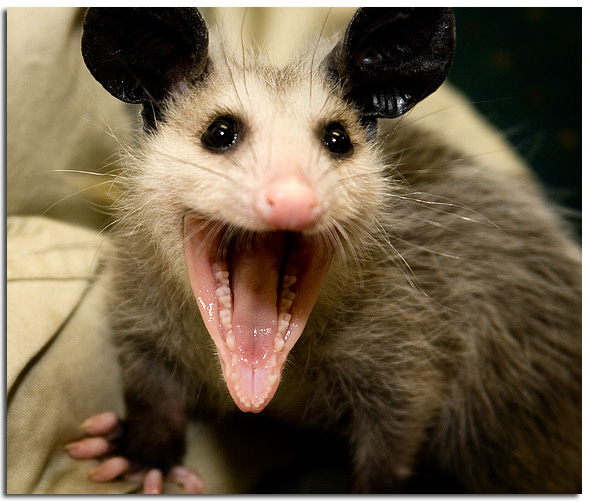
A World of Possum-bilities II
Having just utilized the services of the Santa Barbara Wildlife Care Network to find a home for three baby opossums that were left in my yard I thought I would give them a plug here. The woman I spoke to on the phone said that in a few weeks they will be inundated with birds and mammals and can use all the help they can get. If you want to get some volunteer experience working with animals this is a great opportunity. Their new location in the Fairview Center is convenient for campus too. You can complete an application on their website and they can use you even if you can only spare an hour or two a week.
If you find injured wildlife during the day, you can take it to the Wildlife Care Network located near the OSH store in the Fairview Center in Goleta. After hours, weekends, and holidays, you can take it to the C.A.R.E. Hospital downtown (Garden & Haley) which is conveniently open 24 hours.
Featured
Wednesday, February 11, 2009
A wonderful resource is the Darwin Correspondence Project. Darwin was a prolific correspondent (almost 15,000 of his letters survive!) and the website has the full text of 5,000 of them online and searchable. As well as containing some interesting pages (eg. Six things Darwin never said - and one he did), the website also allows you to simply browse and read the letters. Take a dip, meet Darwin the man.
Tuesday, February 10, 2009
Darwinism must die so that evolution may live
Amidst the plethora of writing on Darwin this week is this gem from the New York Times this morning. It's quite short and everyone should read it since it is so pertinent to our class.Charles Darwin didn’t invent a belief system. He had an idea, not an ideology. The idea spawned a discipline, not disciples. He spent 20-plus years amassing and assessing the evidence and implications of similar, yet differing, creatures separated in time (fossils) or in space (islands). That’s science.
Also of relevance....
TODAY - Tuesday, February 10, 2009, 4:00 pm, MSRB Auditorium 1302
JAMES ZACHOS, University of California, Santa Cruz
"Ocean Acidification and Carbon Cycle Feedbacks During the Late Paleocene and Early Eocene"
Monday, February 9, 2009
Or if you prefer
Marc Cadotte, who is currently pursuing post-doctoral research at the National Center for Ecological Analysis and Synthesis, will be giving the EEMB seminar, today Monday (Feb. 9th) in the MSRB auditorium (1302) at 4pm.
His talk is entitled:
"The community consequences of changes in phylogenetic diversity."
Sunday, February 8, 2009
Collective Motion and Decision Making in Animal Groups
Something a little different:The Mohammed Dahleh Distinguished Lecture in the UCSB College of Engineering
Collective Motion and Decision Making in Animal Groups
by Ian Couzin (Princeton) on Monday at 4PM in Engineering Science Building room 1001 (reception from 3:30PM).
I have it on good authority that Ian Couzin is a superb lecturer and his material is likely to be of interest to many biologists.
Collective organization is ubiquitous, as evidenced from examples ranging from the human brain, in which billions of interconnected cells communicate with chemical and electrical signals, to colonies of army ants capable of coordinating raids, to flocks of birds, to human society. Professor Couzin’s work aims to reveal the fundamental principles underlying evolved collective behavior, including questions of how animal groups move in unison, how individual behavior produces group dynamics, and how animal societies make informed unanimous decisions.
Saturday, February 7, 2009
' A cross between a cow, whale, shark, alligator and sea lion. '
The discovery, along with prior fossil finds, suggests the first whale ancestors were full-time land dwellers that might have been related to the early relatives of hoofed animals, such as sheep and cattle. It lived at the land-sea interface and often moved back and forth between the two environments in what is Pakistan today and looked like an improbable cross between a cow, whale, shark, alligator and sea lion.
Friday, February 6, 2009
Raising Seahorses in Captivity
UCSB Phenology Stewardship Program
If you click on the UCSB Phenology Stewardship Program Official Handbook and download the pdf file you will find a tremendously useful and interesting guide to phenological studies.
Thursday, February 5, 2009
UC Museums
Berkeley, for example, has a tremendous set of museums and has much of their data online and searchable already.
In another lifetime I worked on some websites at Berkeley and one of them had a table of all the departments, research groups and museums studying ecology and environmental change in California. This may be useful link to bookmark if you ever need museum data. Although I notice it's already out of date since I think I did most of the work in 2004 or 2005 and since then CCBER has replaced the Museum of Systematics and Ecology at UCSB. There are also pages of links to field sites, field stations, state agencies and much more.
Remember these are all resources that are available. The use that you put them to is limited only by your imagination.
Wednesday, February 4, 2009
Snake longer than school bus
Reported at Cryptomundo (which has the best headline), Science News, and many more, details are in this week's Nature. Apart from the fact a giant snake is inherently cool, the discovery also sheds light on the paleoclimate.
The maximum body size that a snake species can reach is related to the average annual temperature of the environment in which it lives. So, average annual temperature in Titanoboa’s rainforest probably measured between 32° and 33° Celsius, about 6 degrees C higher than the average temperature in the region today, the team reports.
Researchers knew the temperature was higher 60 million years ago than it is today, but the new finding could help scientists better calibrate models of ancient climate.
I guess Titanoboa is kind of a cool name but I still prefer Beelzebuffo. Beelzebuffo had a better picture too. Am I the only person who thinks the artists reconstruction above would be greatly improved by the addition of a schoolbus?EEMB grad student symposium - UPDATE
9:00 – 9:45 am Registration and Coffee
9:45 – 10:00 am Welcome and Introduction: Dr. Bob Warner Professor and Chair of EEMB
10:00 – 10:30 am Keynote Speaker
Dr. William R. Freudenburg, Dehlsen Professor of Environmental Studies & Bren School affiliated faculty, UCSB
10:30 – 11:50 am Session A talks
• Erin Mordecai - Pathogen effects on plant diversity in a variable environment
• Alisa Hove - Seasonal variation in pollen limitation in two outcrossing species of Clarkia: Does timing matter?
• David Plachetzki - The origins and evolution of the animal phototransduction pathways
• Lindsey Albertson - Impacts of channel reconstruction on invertebrates in a restored river
12:00 – 1:30 pm Lunch (2nd floor balcony)
1:30 – 1:40 pm Post-lunch EEMB extravaganza (PLEEMBE)
1:40 – 3:00 pm Session B talks
• Nathan Derieg - Molecular basis of an adaptive trait: flower color in Aquilegia
• Becca Selden - The effects of predator cues on sea urchin growth, reproduction, and morphology
• Leah Dudley - Plant sex differences in the visiting insect community of a dioecious cushion plant, Laretia acaulis
• Michael Kuehn - Sibling rivalry versus parental control: do parents or their offspring dictate the allocation of resources within a brood?
3:00 – 3:20 pm Mid-afternoon break
3:20 – 4:40 pm Session C talks
• Sabrina Pankey - Molecular evolution of light detection in a bioluminescent squid
• Gail Drus - Synergistic use of biocontrol and prescribed fire for tamarisk (Tamarix spp.) removal
• Kyoungmin Roh - Evolutionary gene network based on shifting balance theory and simulated annealing algorithm
4:40 – 5:30 pm Beer & snacks (2nd floor balcony)
Dinner reception at the Faculty Club starting at 6:00 pm
Tuesday, February 3, 2009
Bone Wars
...the name given to a period of intense fossil speculation and discovery during the late 1800's marked by a heated rivalry between Edward Drinker Cope and Othniel Charles Marsh. Each of the two paleontologists used underhanded methods to out-compete the other in the field, resorting to bribery, theft, and destruction of bones. The scientists also attacked each other in scientific publications, attempting to ruin the other's credibility and cut off his funding.
Cope and Marsh were financially and socially ruined by their attempts to disgrace each other, but their contributions to science and the field of paleontology were significant, and it provided substantial material for further work—both scientists left behind many unopened boxes of fossils after their deaths. The efforts of the two men led to over 142 new species of dinosaurs being discovered and described. The products of the Bone Wars resulted in an increase in knowledge of ancient life, and sparked the public's interest in dinosaurs, leading to continued fossil excavation in North America in the decades to follow.
Blast from the past:
High-performing males have underachieving daughters
Seminar today: Life on the rocks in the deep-sea
KATRINA EDWARDS, University of Southern California
"Life on the rocks in the deep-sea"
Monday, February 2, 2009
EEMB grad student symposium
This is a great, and very efficient, way to find out what grad students actually DO! Unfortunately the schedule isn't online yet but I'm sure it will appear sometime this week.
You are meant to register, but it is free unless you want to attend the dinner. You might even get a free dinner if they still need volunteers (see the registration page).
Sunday, February 1, 2009
From Gene Flow to Genetic Pollution
The seemingly innocent concept of gene flow, the movement of alleles from one population to another, has become a bit of a hot topic in environmental circles since the author Jeremy Rifkin used the term 'Genetic Pollution' in 1998 to describe undesirable gene flow into wild populations. Although this often refers to the flow from genetically modified organisms to wild populations, conservation biologists have also used it to describe the undesirable flow of genes from any captive population to wild populations (eg from salmon in fish farms to local salmon populations).
Greenpeace, for example, have a page specifically about genetic pollution. Yet some people question the use of this term
"If you take a term used quite frequently these days, the term “genetic pollution,” otherwise referred to as genetic contamination, it is a propaganda term, not a technical or scientific term. Pollution and contamination are both value judgments. By using the word “genetic” it gives the public the impression that they are talking about something scientific or technical--as if there were such a thing as genes that amount to pollution.
They use it in terms of GM and in their anti-salmon farming and anti-aquaculture campaigns. If, for example, a fish escapes from a farm and interbreeds with a wild fish of the same species, they call that genetic pollution. They don’t realize that what they are saying in terms of science would be the same thing as saying that if a white person married a Chinese person, that would be genetic pollution."
What's Wrong with the Environmental Movement: an interview with Patrick Moore Competitive Enterprise Institute staff, Environment News 2004 published by The Heartland Institute.
It's an interesting discussion that makes you think about the way that words are used and abused.